
How Much Do Clothing Samples Cost — and Why Do They Cost That?
Every first-time buyer hits the same moment. The bulk price per piece sounds reasonable, then the sample invoice arrives and one lone sweatshirt apparently costs more than buying a finished one in a shop — sometimes several times more. It feels like a toll booth. It isn’t. It’s just what happens when an industrial process gets asked to produce exactly one of something.
What you’re actually paying for
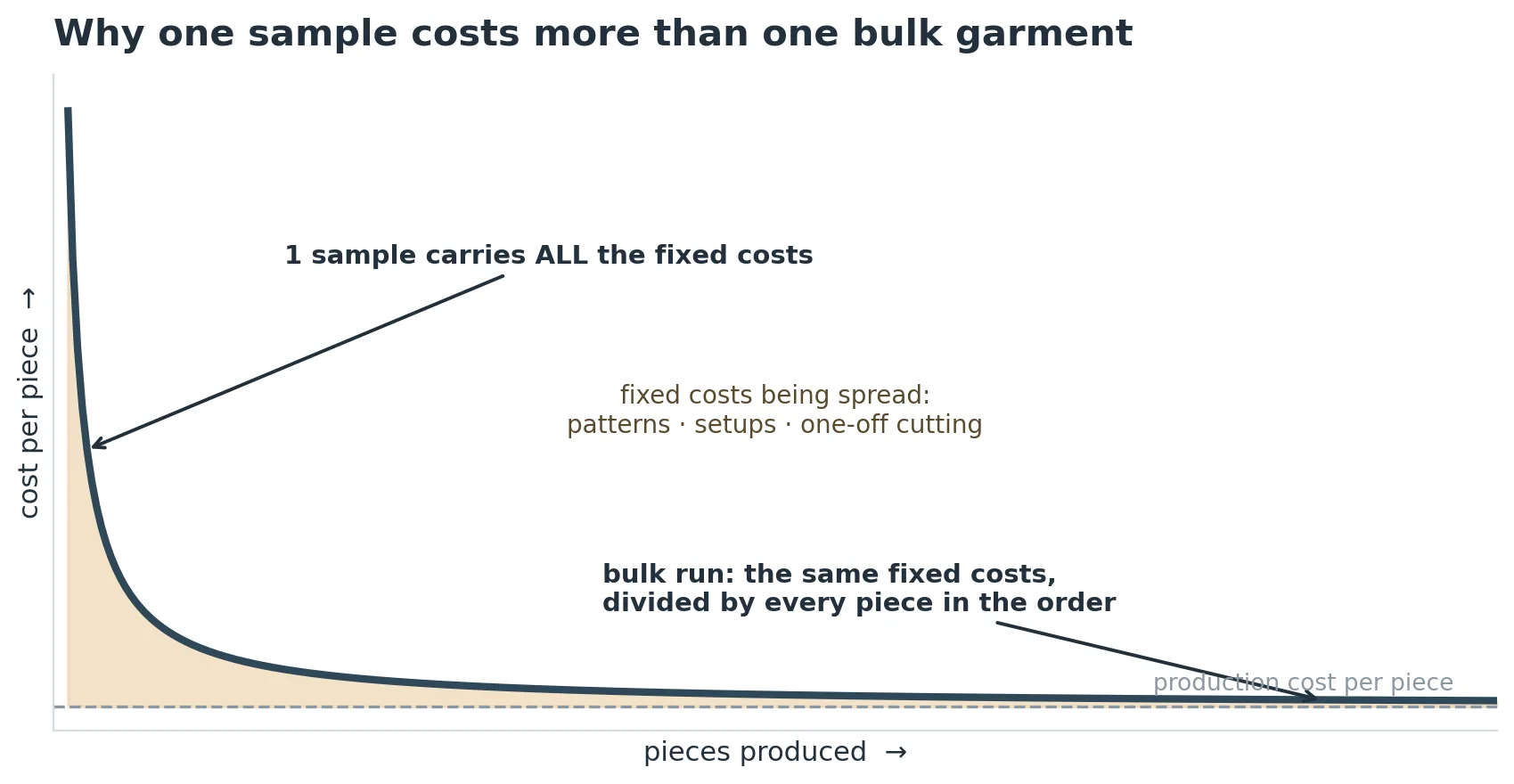
A bulk order spreads its fixed work across thousands of pieces. A sample carries the same fixed work all by itself:
Pattern making. Before anything is sewn, your design becomes a pattern — the physical template every size is built from. Whether it starts from your tech pack, a reference garment or measurements, a pattern maker spends real hours on it, and that work exists whether you order one piece or ten thousand.
One-off cutting. On a production run, fabric is laid in many layers and cut in stacks. A sample is cut piece by piece, often by hand, from fabric that may itself have been bought in a small quantity at a small-quantity price — mills sell fabric by the roll, and one sample’s worth of cloth still has to come from somewhere.
Machine time and a senior pair of hands. Samples aren’t sewn by the fastest line workers. They’re usually made by the factory’s most experienced machinists, the ones who can interpret a spec and solve problems as they go. Slow, skilled, expensive per hour — correctly so.
Setup for every special element. A print needs a screen before it prints once. An embroidery file needs digitising before it stitches once. Custom labels, dyed trims, special buttons — each carries a setup or a minimum purchase behind it, and on a sample there’s no bulk order to hide those inside.
Add it up and the sample isn’t overpriced. It’s un-amortised. The bulk price is the one wearing a disguise: it has divided all of this by your order quantity.
What pushes the price up — and down
Complexity. More panels, more operations, more decoration placements: each one is labour and possibly another setup.
How finished your input is. A complete tech pack samples faster and cheaper than a screenshot and a voice note, because the factory isn’t guessing — and un-guessing. Revisions caused by unclear input are the most avoidable cost in the whole process.
How many versions. Fit samples, pre-production samples, size sets (our guide to the types of clothing samples explains what each one is for) — a full development programme for a multi-size, multi-colour style is several sample rounds, not one garment. Budget for the programme, not the piece.
Revisions. Every “move the pocket, lengthen the body, change the rib” is another trip through cutting and sewing. Some factories include a round or two of revisions in the sample arrangement; some charge per round. Ask at the start — this is exactly the kind of thing our twelve questions list is for.
The two arrangements you’ll meet
Factories handle sample charges differently, and both are legitimate. Some charge a sample fee that is credited back against your first bulk order — the logic being that serious buyers shouldn’t pay for development twice, and tyre-kickers shouldn’t get it free. Some charge the fee outright. And some build sampling into their service for established product categories.
What matters isn’t which arrangement — it’s that it’s written down before you start, including what happens to the fee if you don’t proceed, and whether revisions are inside or outside it. Where Jiajia stands: garment samples and their revisions are free for our categories; you only cover the courier cost of getting them to you. We’d rather be judged on the sample than on a sample invoice.
How to keep sample costs under control
Send the most complete specification you can — every unclear point becomes either a question (slow) or a guess (expensive). Sample your finalists, not your long list: two or three factories, not eight. Consolidate revision comments into one round instead of five drips. And photograph-approve the small things — label placements, trim choices — before they’re sewn, not after.
Do that, and the sample stage stops being a toll booth and becomes what it should be: the cheapest possible place to find out whether this factory, and this garment, are right.
About Jiajia: Zaozhuang Jiajia Garment Co., Ltd. is a knit apparel factory in Shandong, China, making T-shirts, sweatshirts, pajamas, loungewear and children’s knitwear for overseas brands since 2005. Development samples in our categories are free — send your tech pack or reference garment, and cover only the shipping. Contact us
Let’s discuss your collection
Tell us what you are planning to make.