
Why Bulk Production Never Matches the Sample Exactly — and How Good Buyers Manage It
Somewhere near the end of most first orders, a buyer lays the approved sample next to a piece from the bulk run, finds three small differences, and has a bad evening. The shade is a breath off. One measurement sits at the edge of the range. The stitching is very good — and not quite as loving as the sample’s.
Here’s the uncomfortable thing nobody puts on their homepage: some of that gap is physics, not cheating. A sample and a bulk run are made in genuinely different conditions, and pretending otherwise sets both sides up to fail. The skill — on both sides — is knowing which differences are the normal cost of scale, which are failures, and what machinery keeps the first kind from becoming the second.
Your sample was made under laboratory conditions
Think about how a sample gets sewn. One experienced sample maker takes the garment from start to finish, unhurried, with the pattern maker nearby. The fabric is a few metres bought or cut for the purpose. If a seam looks wrong, it gets unpicked and redone on the spot. That garment is the best version of your product that human hands can produce — essentially a prototype built by the factory’s best person, working at walking pace.
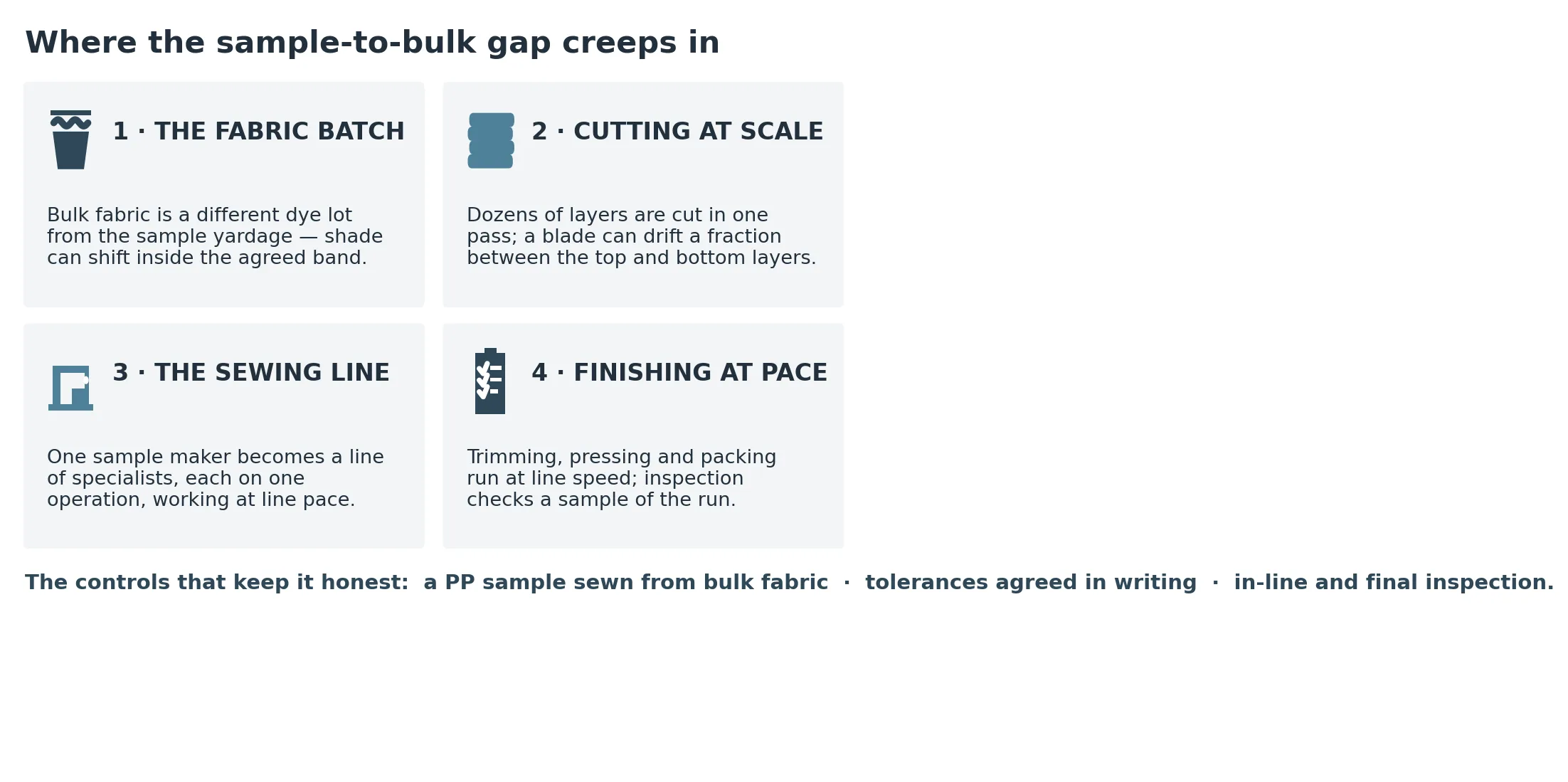
The bulk run gets none of those conditions. It’s the same design meeting industrial reality, and the differences creep in at four predictable places.
1. The fabric is a different batch
Sample yardage and bulk fabric are almost never the same dye lot. Bulk fabric is dyed in full production lots, and dyeing is chemistry at scale: two lots of the “same” colour can sit a shade apart while both are inside the accepted band. Knitting at volume shifts hand feel subtly too, and shrinkage behaviour can vary a little from lot to lot — one reason shrinkage deserves its own checks before production rather than assumptions carried over from the sample.
None of this is visible on a swatch card in isolation. It appears when the sample and a bulk piece share a table — which is why experienced buyers judge shade against an agreed standard under proper light, not against their memory of the sample.
2. Cutting changes at scale
A sample is cut one layer at a time, carefully, by hand. Bulk cutting spreads dozens of layers into a tall stack and drives a blade through all of them — and a blade moving through a tall stack can drift a fraction between the top layer and the bottom one. Pieces from different depths of the same spread can differ by small amounts that a single-layer sample never shows. Good cutting rooms manage this with sharp blades, sane stack heights and checks across the spread; nobody manages it to zero.
3. One pair of hands becomes a line of them
This is the biggest difference and the least talked about. On a production line, no single person makes your garment. One operator sews side seams all day, another sets sleeves, another attaches ribbing — dozens of specialists, each doing one operation at line pace. The best operator on that line is probably not better than your sample maker, and the average piece gets average-of-the-line workmanship rather than best-person workmanship.
What keeps a line honest is balance and supervision: the first pieces off the line get compared against the standard, problems get caught at piece twenty rather than piece two thousand, and operators settle into the style. It’s also why the beginning of a run is the moment to pay attention — a factory that checks early is telling you something about itself.
4. Finishing runs at production pace
Thread trimming, pressing, measuring, folding, packing — on samples these get unlimited care; in bulk they happen at line speed, on every piece, by people whose work is sampled rather than total. A stray thread or a soft press on some pieces is the statistical texture of volume. The question is never “does any piece have a flaw” — at volume, the honest answer is yes — it’s what proportion, of what severity, and what the inspection system catches before the cartons close.
The controls that actually keep bulk honest
If the gap is structural, the answer isn’t hope — it’s a control system, and it’s mostly built before production starts.
The PP sample is the real contract. A pre-production sample is sewn from the actual bulk fabric, on the actual production line, before the run begins. It exists precisely because the development sample can’t represent bulk conditions. Judge bulk against the PP sample and the agreed standards — not against the prototype. (Our guide to garment sample types walks through what each stage is meant to confirm; the PP stage is the one buyers underrate.)
Tolerances get agreed in writing. Measurements carry plus/minus tolerances; shade is judged against an approved range, not a single perfect swatch. If tolerances were never agreed, every difference becomes an argument about expectations. If they were, most differences resolve in one measurement.
Inspection samples the run — properly. In-line checks during production and a final inspection on a statistical sample before shipment are how the flaw proportion gets measured instead of guessed. When you review a sample from production, review it the way you’d review any sample: measurements, construction, finishing, against the written standard. Our sample-review guide is a decent checklist for exactly that moment.
Both sides keep the sealed standard. The approved PP sample, the shade standard, the written specs — kept by the factory and by you, so month-three discussions happen against objects, not recollections.
The buyer’s mindset that works
Don’t ask “does bulk match my sample?” — at volume, the truthful answer is “not exactly, ever, from anyone.” Ask instead: are the differences inside what we agreed, are they the normal kind or the careless kind, and did the factory’s own system find them before I did? A factory that shows you its PP sample, its tolerance sheet and its inspection routine unprompted is showing you the machinery that makes bulk boring. Boring, in production, is the highest compliment there is.
For the sampling stage itself, read what drives the cost of a clothing sample.
About Jiajia: Zaozhuang Jiajia Garment Co., Ltd. has made knit apparel in Shandong, China since 2005 — T-shirts, sweatshirts, hoodies, pajamas and loungewear for overseas brands and wholesalers. If you’re between sample approval and a first bulk order, send us your spec and we’ll walk you through how the PP stage and tolerances would run for your style — before you commit to anything. Contact us
Let’s discuss your collection
Tell us what you are planning to make.