
Clothing Factory vs Trading Company: How to Tell the Difference — and Why It Matters
It usually surfaces the same way. There’s a problem with production — a measurement drifting, a print colour nobody approved — and the person you’ve been emailing for two months says they’ll “push the factory on it”. The factory. Their factory, supposedly. That’s the moment most buyers realise they never actually knew who was making their clothes.
Let’s be fair upfront: trading companies are not a scam category. Some are excellent — organised, honest, genuinely useful. The problem is narrower than that. The problem is signing up for one model while believing you’ve got the other, because price, control and accountability run on completely different rules in each.
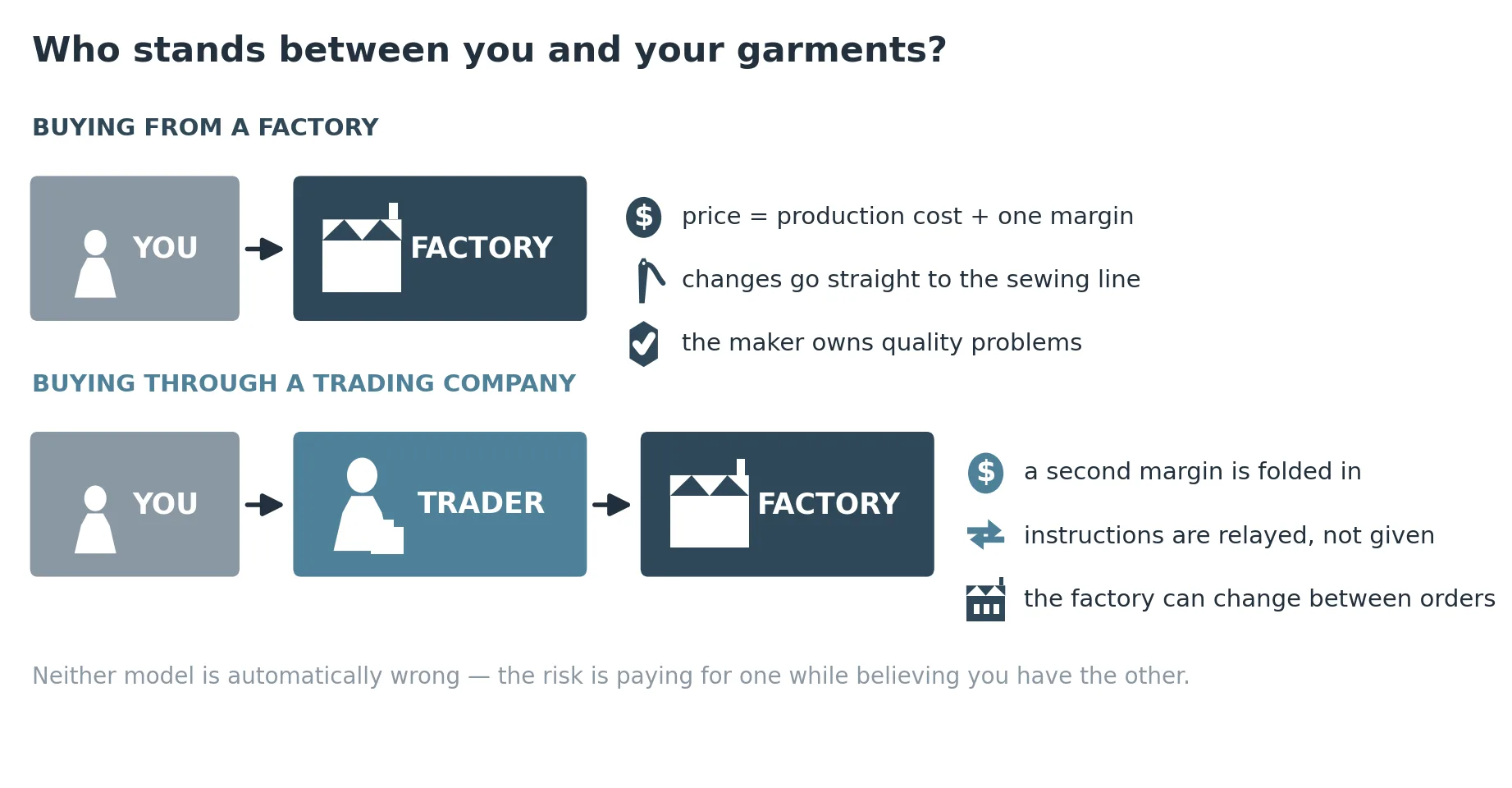
What actually changes between the two models
The price you pay. A factory quotes its own cost of making your garment, plus its margin. A trader quotes a factory’s price with a second margin folded in. Same garment, two different cost structures. Traders can occasionally beat a factory’s direct price — they aggregate small buyers into real volume — but you should know which structure you’re paying for, and why.
Who can change things. Mid-production, you spot that a cuff rib is narrower than spec. A factory walks ten metres and fixes it on the line. A trader forwards your message to a factory you’ve never met, in wording you never saw. Every relay is a small game of telephone played with your money.
Who owns a problem. When a shipment arrives wrong, a factory has nowhere to point: it made the goods. With a trader in the middle, fault can orbit for weeks — the factory blames the instructions it received, the trader blames the factory’s execution, and you hold the container.
Whether your factory stays your factory. This one catches people out on the second order. Traders can, and do, move production between workshops to protect their margin. Your samples were sewn in one place; your bulk in another; your reorder in a third. If a re-order feels subtly different from the original and nobody can explain why, this is the usual reason.
Five tests that sort it out
None of these requires detective work. They mostly require asking ordinary questions and paying attention to the texture of the answers.
1. Ask technical questions and time the answers. Construction, grading, stitch types, how a print gets placed across a size run. A factory answers from the floor — quickly, specifically, sometimes with a photo of the exact operation. A trader’s answers arrive after a consultation you weren’t part of. One delay means nothing. A delay on every single question is the answer.
2. Direct a live video call. Not their promotional video — yours. You choose the route: cutting tables, the lines sewing your category right now, the inspection and packing area. A factory can do this on a normal working day because the floor is simply there. A trader will offer a showroom tour, a recorded video, or a very reasonable explanation of why today doesn’t work. (Our verification checklist walks through what to look for on that call, section by section.)
3. Read the catalogue like a detective. Factories are narrow by physical necessity. Their lines, machines and workers are set up for particular categories — knits, say: T-shirts, sweatshirts, pajamas, loungewear. A supplier offering denim, tailored dresses, swimwear and knit pajamas from “our factory” is describing a network, not a floor.
4. Line up the names on the paperwork. Business licence, quotation, proforma invoice, payment beneficiary. A factory selling its own production tends to be one company, start to finish. When the name changes at every step — one company quotes, a second invoices, a third gets paid — you’re looking at a chain, and you are at the end of it.
5. Let the sample round speak. Send a real specification and watch how it’s handled. A factory pushes back where your spec collides with how garments are actually made, and suggests the workable version. That pushback is gold — it’s a maker thinking. A trader more often accepts everything exactly as written and passes it down the line. Total agreement at sample stage frequently becomes total surprise at bulk stage.
A caveat, because life is untidy: a strong trader can pass several of these, and a large factory’s export office can look suspiciously corporate. No single test convicts anyone. You’re looking at the overall pattern.
When the trading company is genuinely the better choice
Sometimes it is, and pretending otherwise would make this a sales pitch instead of a guide.
If your range spans categories no single factory covers — knit tops from one place, woven bottoms from another — a good trader earns their margin coordinating it. If your per-style quantities are small and scattered, a trader’s aggregated volume may get you made at all. And if what you value most is one accountable contact who handles the chaos for you, a trader you’ve worked with for years can be worth every point of their margin.
The word that matters in all three cases is knowingly. Choose the model; don’t discover it.
The short version
You don’t need to accuse anyone of anything. Ask technical questions. Take the video call and hold the map. Check whether the catalogue looks like one floor’s work. Compare the names on the documents. Judge the sample round. A real factory passes these tests without breaking stride — because every one of them just asks it to show you an ordinary Tuesday.
To build that shortlist in the first place, see how to find clothing manufacturers in China.
About Jiajia: Zaozhuang Jiajia Garment Co., Ltd. is a knit apparel factory in Shandong, China, making T-shirts, sweatshirts, pajamas, loungewear and children’s knitwear for overseas brands since 2005. When you write to us, you’re writing to the factory — take the live tour, ask the awkward technical questions, and judge us on the sample.
Let’s discuss your collection
Tell us what you are planning to make.