How to Verify a Clothing Factory in China Before You Place an Order
Finding a factory takes an afternoon. Type what you make into Google or a sourcing platform and you will have fifty names by dinner. The hard part is the next question: which of those websites belongs to a company that actually sews your product, controls what happens on the line, and picks up the phone when a carton count comes up short?
Buyers who source from China year after year run some version of the checklist below before a first order. It is not glamorous work. It is mostly comparing names on documents and asking slightly awkward questions. But it is cheaper — much cheaper — than learning the same things from a bad bulk shipment.
Start with the paperwork, boring as it sounds
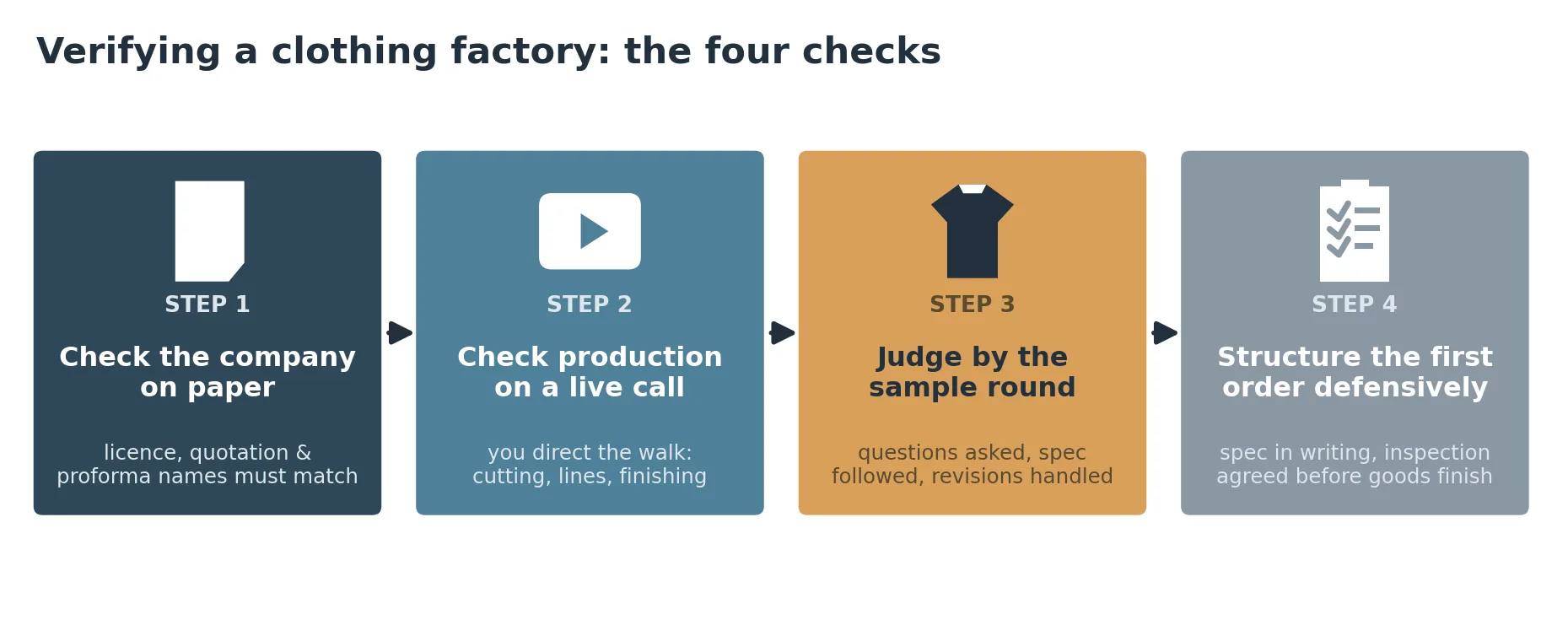
Ask for the business licence first, before you get into styles and prices. Then read it against the other documents you already have. The company name on the licence should match the name on the quotation. Both should match the name on the proforma invoice, and the beneficiary of your payment should be that same company.
When those names don’t line up, there is usually a story. Sometimes it’s innocent — a group company, an export arm. Sometimes it means the business you are negotiating with is not the business making your clothes, and not the business you are paying. Either way, you want the explanation now, in writing, not after the deposit has moved.
While you have the licence out, check two more things. How long has the company been exporting, and to which markets? A factory that ships to your region regularly already knows your labelling rules and your carton expectations. And is your category actually its main line? A plant tooled for woven shirts runs different machines and different skills than a knit cut-and-sew floor. If you make T-shirts, sweatshirts, pajamas or loungewear, you want the factory whose lines are set up for knits — not one that will learn on your order.
Factory or trading company? Find out now, not later
Plenty of trading companies are honest and competent. This isn’t about catching villains. It’s about knowing who controls your production, because that decides who can actually fix a problem at 11 p.m. your time.
The fastest tell is how technical questions get answered. Ask about construction. Ask about grading, about how they handle a print placement across sizes, about packing. A factory answers from its own floor, sometimes with a photo attached. A trader answers after a pause — the “let me confirm with our factory” pause. One pause proves nothing. A pause on every question is a pattern.
The second tell is range. Real factories are narrow. They make a defined set of categories and they make them in depth. When a single supplier cheerfully offers denim, evening dresses, swimwear and knit pajamas, you are almost certainly looking at someone aggregating other factories’ output. (We wrote a separate piece on this — factory vs trading company — if you want the full set of tests.)
Don’t watch their video. Direct your own.
Every supplier has a factory video. It will have drone shots. It proves nothing.
What proves something is a live call where you hold the map. Ask them to walk, slowly, and to stop where you say: the cutting tables — is fabric for current orders stacked and labelled, or in anonymous piles? The sewing lines — what is actually being sewn today, and is it in your category? The finishing area — where garments get inspected, pressed, folded. Ask them to pick a finished piece off the line and bring it close to the camera.
You are not judging whether the floor is beautiful. Plenty of excellent factories are not beautiful. You are checking that it is real, busy, and set up for your kind of product.
Ask how quality control works — then ask what happens when it fails
“High quality” is the most overworked phrase in sourcing. Skip it and ask about the mechanism instead.
Where does inspection happen — during production, at the end, or both? If final inspection follows a recognised standard, which one, and can it follow yours? And the question suppliers least expect: when a defect rate crosses the line after shipment, what happens? Who pays for what?
A factory with a real QC routine answers these questions the way a driver describes a route they take every day — specifically, without reaching for adjectives. Vague pride at this stage usually means there is no routine, just hope.
Ask for recent production in your category, too. Not the showroom samples — every factory keeps beautiful showroom samples. Ask what they shipped last season for buyers like you.
Treat the sample order as the real interview
Documents tell you the company exists. A sample round tells you how it works, and honestly, this is where verification stops being research and becomes evidence.
Send a proper specification — a tech pack if you have one, a reference garment, or at minimum a detailed brief (we have a guide on preparing a production brief if you’re starting from a sketch and a prayer). Then watch the behaviour, not just the garment:
How many questions come back before they start? Good factories ask about measurements, construction, trims, packing. Factories that ask nothing are not being efficient. They are saving their guessing for your bulk order.
When the sample arrives, does it follow the spec or their reading of it? And when you send revision comments — and you should, even small ones — how do they land? This back-and-forth, tedious as it is, is a rehearsal for bulk production. If communication is sloppy now, it will not improve at 5,000 pieces. (Our guide to reviewing a garment sample walks through what to check when it lands on your desk.)
Structure the first order like you might be wrong
Even a verified factory is an unproven one, for your product, until the first bulk ships. So set the first order up defensively:
Get the full specification confirmed in writing before production — sizes, colours, construction, labelling, packing. Not in a chat thread. In a document both sides have signed off on.
Agree how inspection will happen before the goods are finished, while there is still time to act on what it finds.
And keep the money trail boring: payment terms spelled out on the proforma invoice, beneficiary matching the licensed company from step one.
The red flags, collected in one place
- A price far below every other quote for the same specification, with no explanation of where the saving comes from
- A live factory call that is always postponed — the floor is busy, the manager is away, next week is better
- A payee company that doesn’t match the licence or the quotation
- A supplier who never asks you a single question about your specification
- Pressure to scale up the first order before samples are approved
Any one of these can have an innocent explanation. Three of them together is your answer.
The short version
Check the company on paper. Check the production on a live call you direct. Check the working relationship through a sample round. Then structure the first order so quality gets verified before the goods leave. Buyers who do these four things rarely have disaster stories — mostly because the factories that cause disaster stories excuse themselves somewhere around step two.
Still building your shortlist? Start with how to find clothing manufacturers in China.
About Jiajia: Zaozhuang Jiajia Garment Co., Ltd. has produced knit apparel in Shandong, China since 2005 — T-shirts, sweatshirts, pajamas, loungewear and children’s knitwear for overseas brands and wholesalers. We expect to be verified: send us your tech pack or reference sample, take a live tour of our floor, and judge us on the sample we send back. Contact us
Let’s discuss your collection
Tell us what you are planning to make.