
How to Find Clothing Manufacturers in China: Channels That Actually Work
Here’s the uncomfortable starting point: you are not looking for a manufacturer. Manufacturers are everywhere — a search engine will give you hundreds before lunch. You are looking for a manufacturer whose main line is your product, who already exports to your market, and who will still care about your order in month six. Filtering down to that company is the real job, and the channel you search through changes what you find.
Channel 1: Search engines — slower, but you see the factory’s own face
Google “pajama manufacturer China” or “custom sweatshirt manufacturer” and work through the actual factory websites, not just the first page of ads. A factory’s own site tells you things a platform listing never will: how focused its range is, whether it speaks to brands like yours, whether it shows a real production floor or only stock photos.
This route is slow and the first page is crowded with companies that are simply better at marketing than sewing. But it’s the only channel where you deal with the factory directly from the first click — no platform in between, no commission quietly built into your price. Regional searching helps: garment production clusters by city and province, and factories in a knit cluster (Shandong, the Pearl River Delta, Zhejiang) sit inside a supply chain of fabric mills and trim suppliers that makes them faster and cheaper on their home categories.
Channel 2: B2B platforms — great phone book, bad character witness
Alibaba and Global Sources are where most buyers start, and as a directory they’re genuinely useful: thousands of suppliers, searchable by product, with years of listing history. Use them to build a candidate list.
Just don’t confuse the platform’s badges with verification. A supplier’s storefront is written by the supplier. The factory photos, the capacity numbers, the “gold supplier” framing — all of it is marketing until you’ve checked it yourself. Platform listings are also where factories and trading companies blur together most; a polished storefront can belong to either. Treat the platform as a phone book: it gives you names and numbers. Deciding who’s real is a separate job (our factory verification checklist covers it, and our factory-vs-trading-company guide explains why the distinction changes your price and your control).
Channel 3: Trade shows — the handshake still works
The Canton Fair and the big apparel sourcing shows remain the one channel where you can hold a factory’s garments in your hands and look the sales manager in the eye, which still counts for a lot. Walking a show, you also learn the going shape of the market in a day: who makes what, at what quality level, aimed at which buyers.
The limits are obvious — cost, timing, and the fact that the factories exhibiting are the ones with export departments big enough to exhibit. Plenty of excellent mid-size factories never take a booth. Shows are best used the same way as platforms: to build the candidate list, not to conclude it.
Channel 4: Trade data — search backwards from real shipments
Here’s the channel experienced buyers use and beginners rarely know exists: shipment records. Services that publish customs and bill-of-lading data (some have free tiers) let you search by product and see which factories actually shipped knit pajamas, sweatshirts or T-shirts to buyers in your country last season — and often, which buyers they shipped to.
This flips the whole search. Instead of reading what a supplier claims to make, you’re reading what it demonstrably made and exported, recently, at real volumes. A factory with steady shipments of your category to your market has already passed tests that no questionnaire can fake. If your competitors’ suppliers are visible in the data, that’s not spying — it’s the same research every professional sourcing team does.
Channel 5: Agents and referrals — leverage, with a price tag
A sourcing agent earns a margin or a fee for knowing the landscape you’re just entering. For a first order in a category you don’t understand, that can be money well spent — a good agent’s factory relationships took years to build. The trade-off is structural: the agent stands between you and the factory, learns your business, and takes a cut of every order forever. Many brands start with an agent and move direct once they know their product.
Referrals from other brand owners are the warmer version of the same thing — a factory that performed for someone whose standards you trust. Ask in founder communities and industry groups. One honest “they messed up our first run, fixed it without a fight, and have been solid since” is worth fifty directory pages.
Build the shortlist like a buyer, not a browser
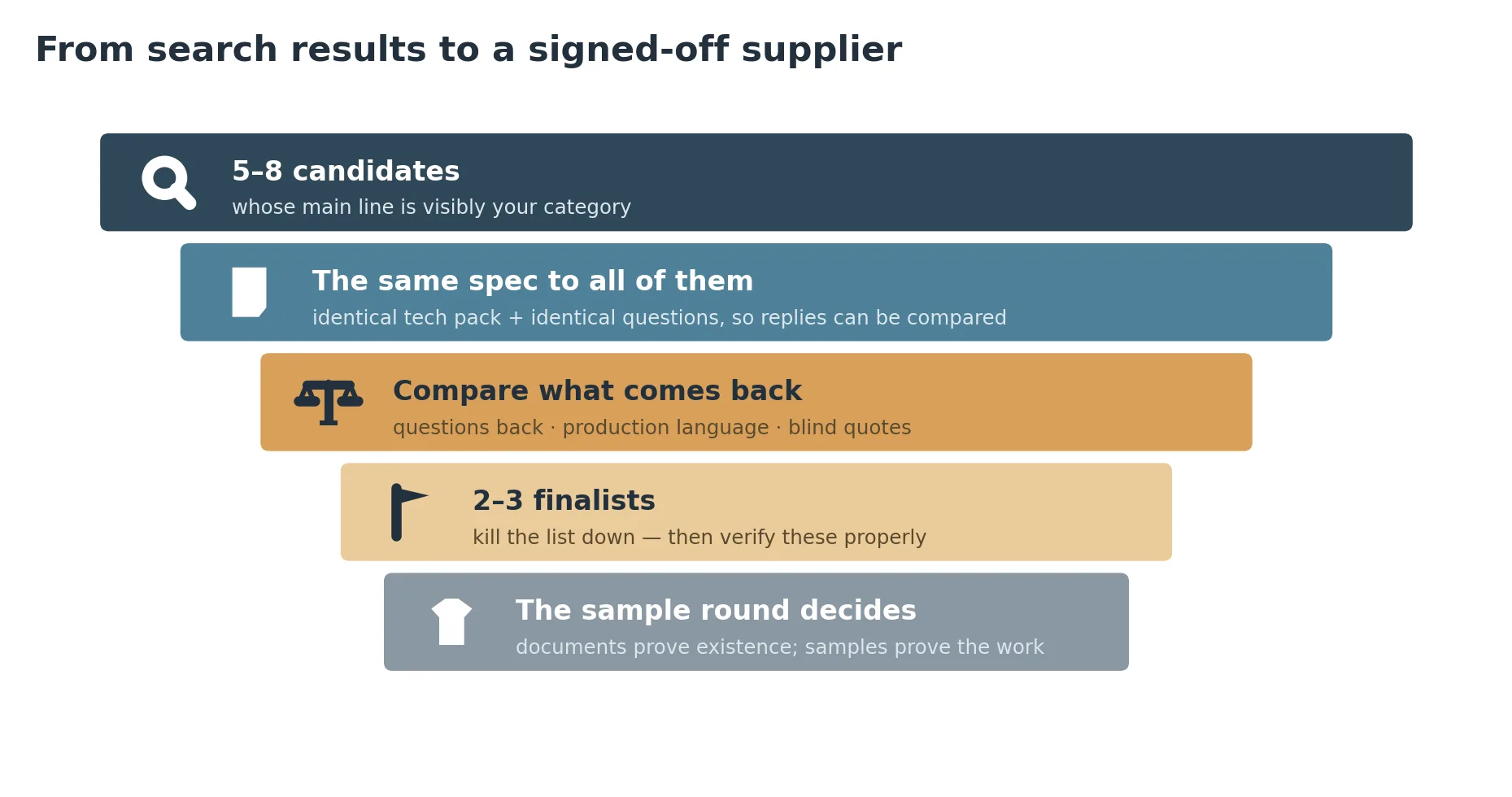
Whichever channels you use, the method at the end is the same:
- Collect five to eight candidates whose main line is visibly your category.
- Send every one the identical specification — same tech pack or reference, same questions — so the replies can actually be compared.
- Watch what comes back: who asks questions, who answers in production language, who quotes a price with nothing behind it.
- Kill the list down to two or three. Then verify those properly and let a sample round make the final decision.
Finding names is an afternoon. The buyers who source well aren’t better at finding — they’re more disciplined about filtering.
About Jiajia: Zaozhuang Jiajia Garment Co., Ltd. is a knit apparel factory in Shandong, China — T-shirts, sweatshirts, pajamas, loungewear and children’s knitwear for overseas brands since 2005. If your shortlist has a space on it, send us the same specification you sent everyone else and compare what comes back. Contact us
Let’s discuss your collection
Tell us what you are planning to make.