
12 Questions to Ask a Clothing Manufacturer Before You Place an Order
Most first conversations with a manufacturer go the same way: you describe your product, they say yes, a price appears suspiciously fast, and both sides hang up knowing almost nothing about each other. The problem isn’t the factory’s answers. It’s that the questions were too soft to reveal anything.
The twelve below are the ones experienced buyers ask before a first order. They’re grouped by what they’re really testing — and for each, what matters isn’t just the answer. It’s how the answer sounds.
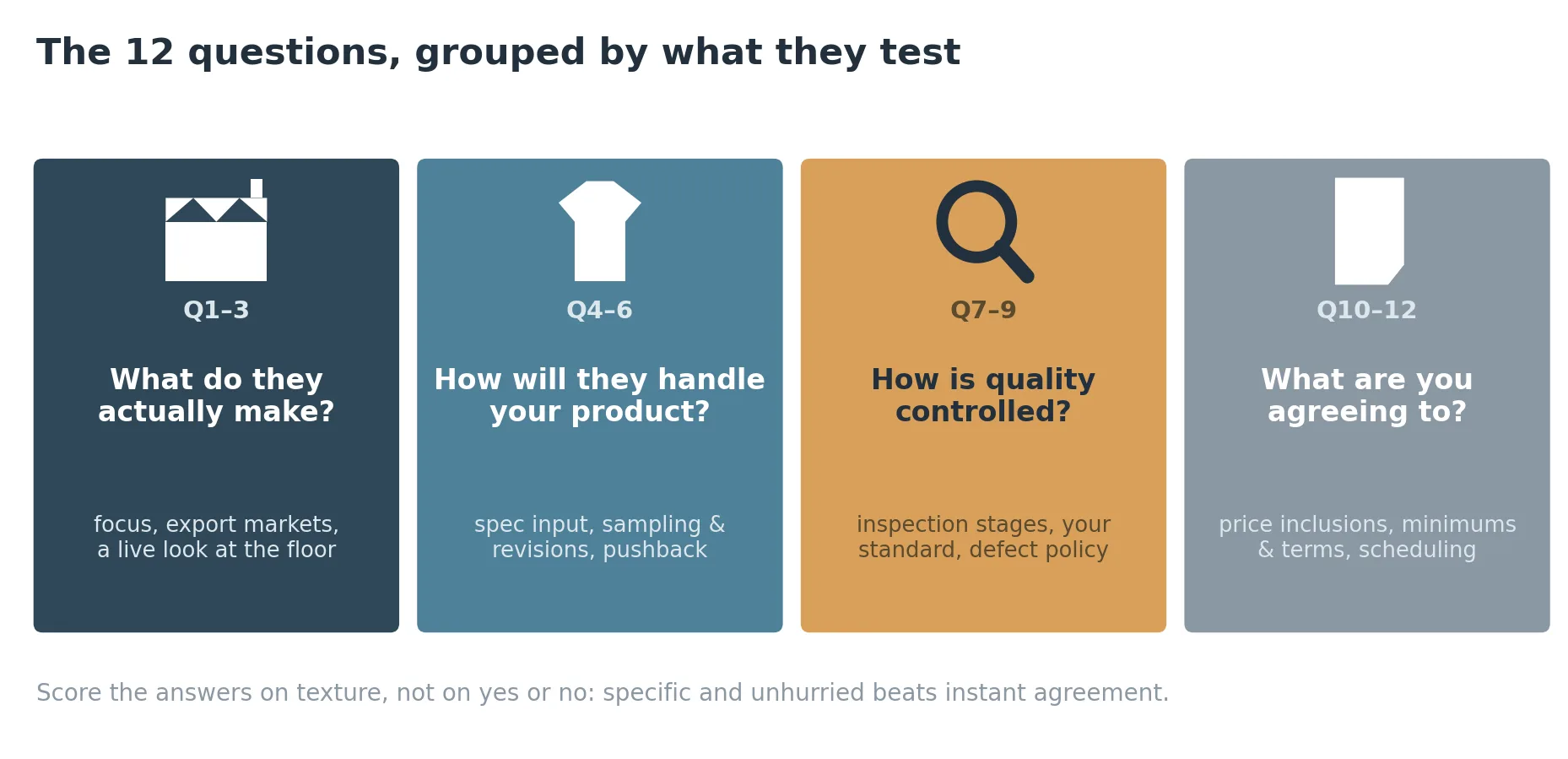
First: what do they actually make?
1. “What is your main product range — and what share of your production is it?” You’re checking focus. A factory lives on its main line: the machines are set up for it, the workers are fast at it, the fabric supply chain behind it is warm. Your product should sit in the centre of what they do, not at the edge. A knit factory whose floor runs T-shirts, sweatshirts and pajamas daily will handle your knit order very differently from a generalist taking it as a side job.
2. “Which markets do you export to, and how long have you exported?” Labelling rules, size conventions and carton expectations differ by country, and a factory already shipping to your market has learned them on somebody else’s orders. A good answer names countries and years without hesitation.
3. “Can I see current production, live?” You are not asking for a promotional video — everyone has one, and it proves nothing. You’re asking for a live walk-through of what’s being sewn today. Factories say yes easily because the floor is just there. Reluctance here is information. (Our verification checklist explains what to look for on that walk.)
Then: how will they handle your product?
4. “What do you need from me to start a sample?” Their answer tells you how professional the development process is. A serious factory asks for a tech pack or a reference garment, measurements, construction details — it names what it needs because it knows what can go wrong without it. “Just send a picture” is how misunderstandings get sewn in. (If you’re preparing your side of this, our production brief guide covers what a factory needs to receive.)
5. “What does sampling include, and how do revisions work?” Samples get revised — that’s normal, that’s their job. What you need to know upfront: what’s included, how changes are communicated, what’s re-made versus adjusted. Ask now, not after the second revision lands wrong.
6. “What would you change about my specification?” This is the connoisseur’s question. Real makers see problems in a spec — a construction that won’t sit right, a detail that will fight the machine, a tolerance that’s asking for trouble — and they’ll tell you, because they’ll be the ones living with it at bulk stage. A supplier who finds nothing to question in any spec is either not reading it or not making it.
Then: how is quality controlled?
7. “Where does inspection happen — during production, at the end, or both?” End-of-line inspection catches problems after thousands of pieces exist. In-line checking catches them while they’re still cheap. You want to hear a routine, described plainly: who checks, at which stages, against what.
8. “Can final inspection follow my standard?” If you inspect to a recognised standard or your own checklist, say so and watch the reaction. Factories that export seriously deal with buyer standards routinely. Surprise or pushback at this stage predicts an argument at shipment stage.
9. “When a defect rate is over the line, what happens?” Awkward, necessary. Every factory has defects sometimes; the professional ones have a policy for it. “That never happens to us” is not a policy. A clear answer — what gets reworked, remade or credited, and how it’s decided — is a sign you’re dealing with people who have stood behind shipments before.
Finally: what exactly are you agreeing to?
10. “What does your quoted price include?” Two quotes for the “same” garment are rarely for the same thing. Does the price cover fabric, trims, your labels and tags, packing? Export-side costs or not? Get the inclusion list in writing and the quotes from different factories suddenly become comparable — often the cheapest one was just quoting less garment.
11. “What are your minimums per style and colour, and your payment terms?” Ask plainly and write it down. Minimums shape how you plan a range — how many colours you can open with, how you test a new style. Payment terms shape your cash flow. Neither should be discovered on the proforma invoice.
12. “How is production scheduled, and how will I hear about progress?” You’re not extracting a promise — you’re learning how they run. Who updates you, at which milestones, and what a realistic schedule is built from (fabric arrival, cutting, sewing, finishing) tells you whether production is managed or improvised. Silence during production is what buyers actually fear; ask how it’s prevented.
How to use the answers
Don’t score factories on yes/no. Score them on texture. Specific, unhurried answers — with questions coming back at you — are what competence sounds like in this industry. Instant agreement with everything, prices quoted before specs are understood, and vagueness exactly where money and quality meet: that’s what risk sounds like.
Ask the twelve, in writing, to everyone on your shortlist. The comparison will pick your factory for you.
About Jiajia: Zaozhuang Jiajia Garment Co., Ltd. has made knit apparel in Shandong, China since 2005 — T-shirts, sweatshirts, pajamas, loungewear and children’s knitwear for overseas brands and wholesalers. Ask us these twelve. We’d rather answer hard questions before your order than easy ones after it. Contact us
Let’s discuss your collection
Tell us what you are planning to make.