
What Determines a Clothing Manufacturer’s Minimum Order Quantity?
Almost every small brand has the same story. You find a factory you like, the samples come back right — and then the minimum order quantity lands, higher than your whole first season’s budget, and the conversation stalls.
The natural conclusion is that the factory is being difficult, or greedy, or doesn’t want small customers. Sometimes that’s true. More often, the number you’re staring at isn’t really the factory’s number at all. An MOQ is a stack — minimums piled up from every supplier behind the factory — plus the economics of setting up a production line for your style. Pull the stack apart and it starts to make sense. More usefully, you can see which layers of it can actually move.
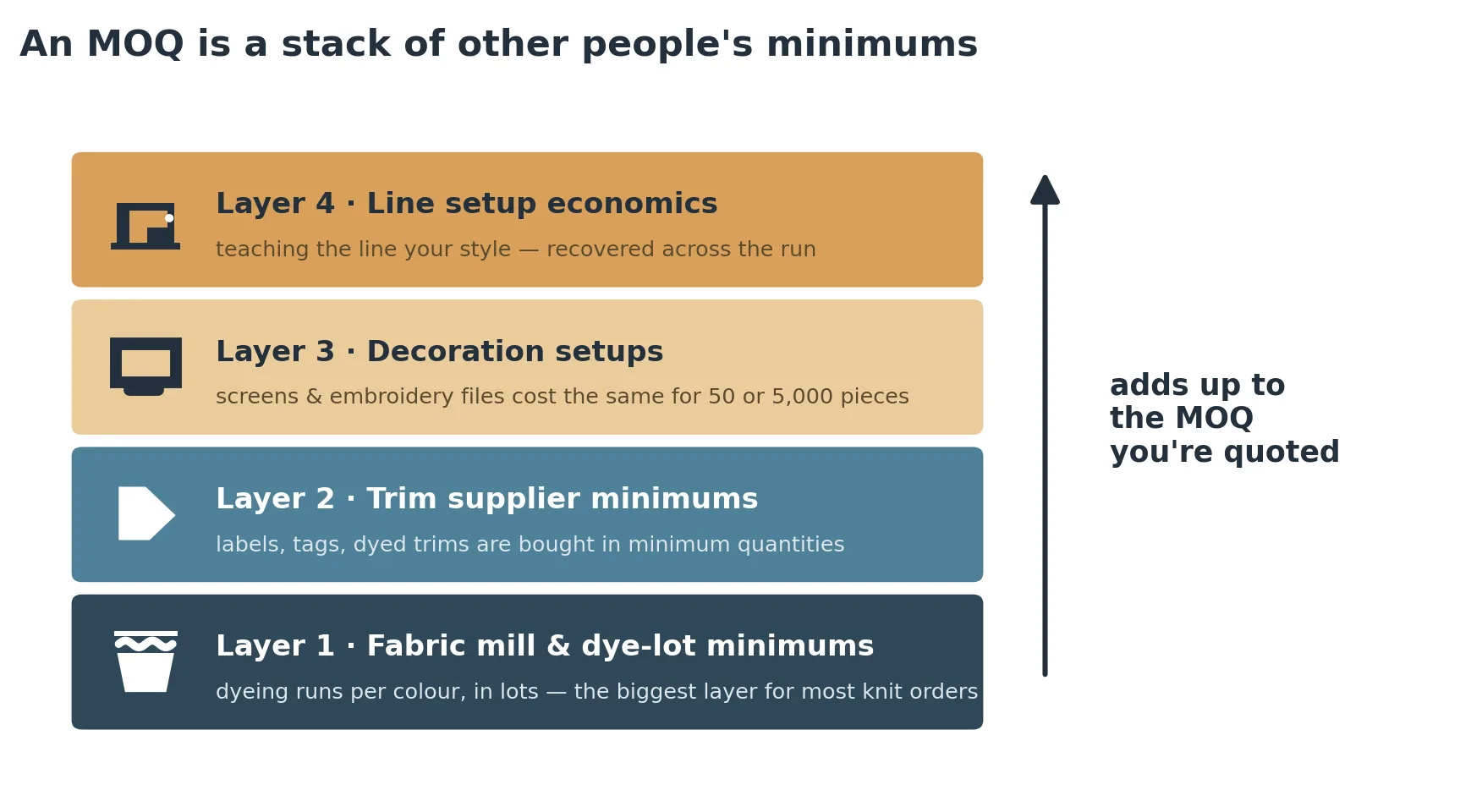
Layer 1: The fabric mill’s minimum, not the factory’s
Your garment factory does not make fabric. It buys fabric from a mill, and the mill has its own minimums — especially for dyeing. Dyeing is done in lots: a vat gets set up for one colour, and below a certain quantity of cloth the lot simply isn’t run. So when a factory tells you a minimum per style per colour, a large part of that number is the dye lot wearing a disguise. Change the colour, and the minimum restarts — new dye lot, new setup. This is why “500 pieces across five colours” and “500 pieces in one colour” are completely different orders to a factory, even though they sound identical to a buyer.
The escape hatch, when there is one: stock fabric and stock colours. Cloth the mill already holds, in colours already dyed, skips the dye-lot minimum entirely. This is the single biggest lever on MOQ for most knit garments.
Layer 2: Trims have minimums too
Custom labels, printed tags, dyed-to-match drawcords, branded buttons — each comes from a supplier with a minimum purchase, and below that minimum the item either can’t be bought or costs absurdly per piece. Small brands feel this as a mystery surcharge on small orders; it’s arithmetic, not attitude. Stock trims and standard components soften it, the same way stock fabric does.
Layer 3: Decoration setups are fixed costs
A print screen, an embroidery file, a heat-transfer setup — each is created once per design and costs the same whether it decorates fifty pieces or five thousand. On a small run, setups sit heavily on every unit (we covered this in our breakdown of where a garment’s price comes from). Factories fold that reality into their minimums rather than explain it line by line.
Layer 4: The line itself
Restarting a sewing line for a new style is not free. Cutting one style’s layout, rebalancing workers to new operations, the slower first hours while the line learns the garment — a factory absorbs a fixed chunk of setup and inefficiency on every new style, and recovers it across the run. Short run, same setup: the maths only works above a certain size, and that size becomes part of the MOQ. It’s also why a repeat order of a proven style is often negotiable in a way a first order isn’t — the patterns exist, the line has learned, half the setup cost is already history.
So what can a smaller brand actually do?
Negotiating “the number” head-on rarely works, because the number isn’t one decision. Negotiating its layers does:
- Consolidate. Fewer colours per style, deeper quantity in each, buys you under the dye-lot layer. Launch in two colours that sell, not five that dilute.
- Take stock options where they exist. Stock fabric colours and standard trims can collapse the first two layers at once. Ask the factory what it can source without special minimums — this question alone changes the quote.
- Ask which layer is binding. “What’s driving the minimum on this style — the fabric, the dyeing, or the line?” is a question factories respect, because it shows you understand the stack. Sometimes the answer surprises both sides: one component is driving everything, and swapping that one component reopens the order.
- Sequence your range. Open with the styles that clear the minimum comfortably, build the sales history, and bring the experimental styles in on reorders, when your leverage and the factory’s flexibility are both better.
The honest summary
An MOQ is not a wall a factory built to keep you out. It’s the shadow cast by everyone standing behind the factory — mills, dyers, trim suppliers, setups — plus the cost of teaching a line your garment. Some of that shadow is fixed. More of it than most buyers realise is negotiable, once you stop pushing on the number and start asking about its layers.
About Jiajia: Zaozhuang Jiajia Garment Co., Ltd. has made knit apparel in Shandong, China since 2005 — T-shirts, sweatshirts, pajamas, loungewear and children’s knitwear for overseas brands and wholesalers. If a minimum is standing between you and a first order, ask us which layer is driving it. Sometimes the answer is a stock fabric away. Contact us
Let’s discuss your collection
Tell us what you are planning to make.