
What Decides the Price of a Custom Clothing Order? A Cost Breakdown
Ask three factories to quote the same sweatshirt and you’ll often get three prices far enough apart that somebody must be lying. Usually nobody is. They’re quoting different garments that happen to share a description — because “a sweatshirt” isn’t a cost. The cost is buried in a dozen smaller decisions, most of which were never written down in the enquiry.
So here’s where the money actually goes, line by line, in roughly the order it leaves your pocket.
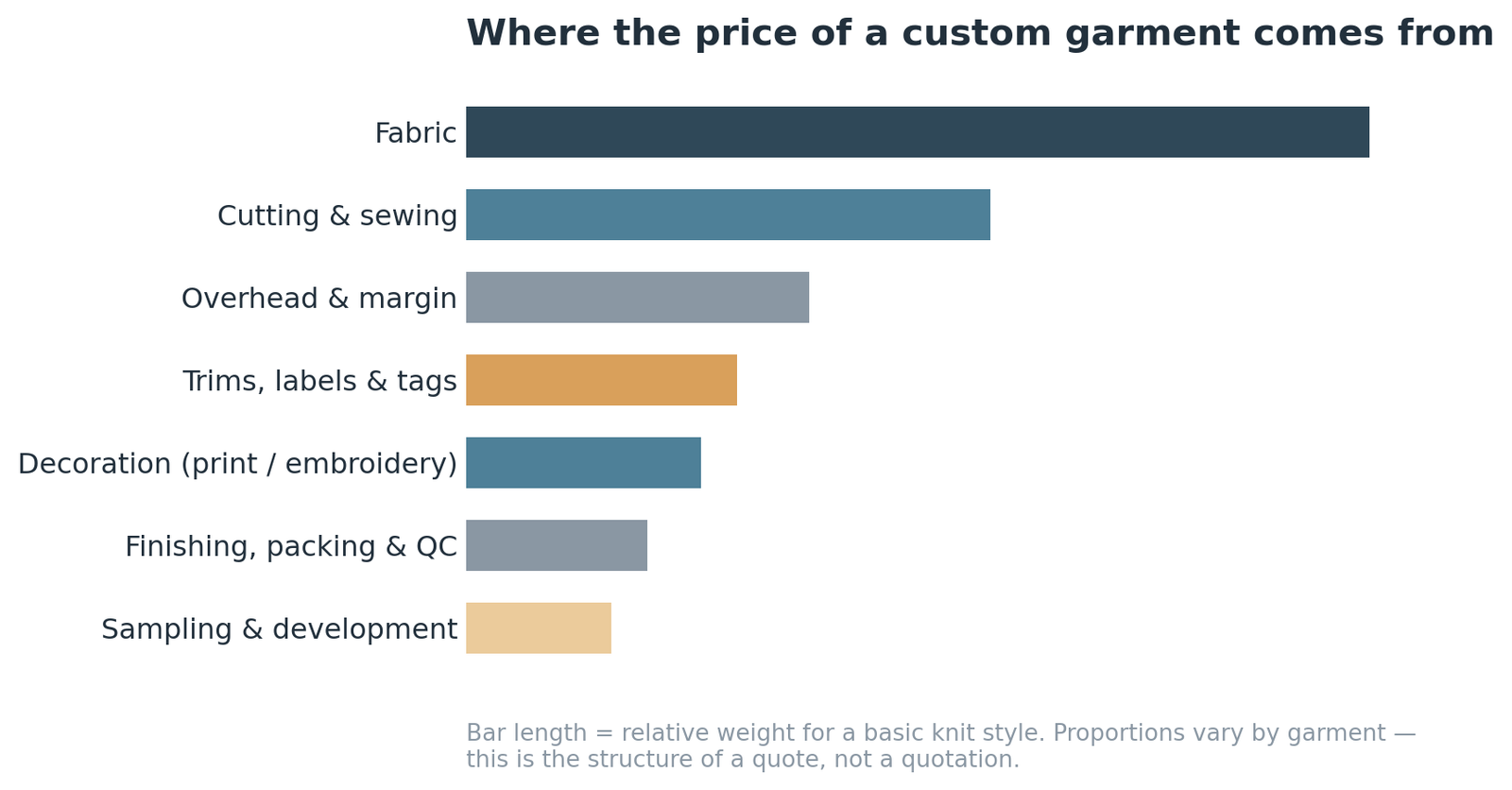
Fabric: the big one
On most basic knit garments, fabric is the largest single cost — commonly more than everything else combined. That’s why two “identical” quotes diverge first here: different fabric weights, different cotton grades, different dyeing standards. A cheaper fabric is not a discount; it’s a different garment.
This is also where cheap quotes quietly cheat. The fabric in your sample and the fabric in a suspiciously low bulk quote are not always the same fabric — especially on weight and shrinkage. If a quote undercuts the market by a wide margin, the first document to ask for is the fabric specification, not a better price.
Fabric cost is driven by material, weight and quantity, in that order. Organic or recycled cotton costs more than conventional. Heavier fabrics consume more material per garment. And larger orders spread dyeing and finishing minimums across more pieces, which is one reason a low MOQ often looks expensive.
Two practical checks before you commit: does the quote name the material, weight and origin — and does the bulk fabric match the approved sample? If either is vague, the price you’re looking at isn’t the price you’ll pay.
Trims and components: the small print that isn’t small
Zips, buttons, drawcords, elastic, thread, labels, tags, polybags. Individually trivial, together a visible slice of the cost — and unlike fabric, they’re easy to overlook when comparing quotes. A quote that looks cheap sometimes achieves it by assuming generic, unbranded components where you assumed custom.
Ask which trims are included, and whether branded or custom labels are priced in. If your specification calls for a metal zip and a quote assumes plastic, the “saving” is a downgrade, not efficiency.
Cutting and sewing: the labour line
This is the part people imagine when they think “factory price” — people at machines. It’s driven by how long a garment takes to sew: the number of operations, the construction complexity, and whether the factory runs efficiently or reworks constantly. A garment with a hood, kangaroo pocket, ribbed trims and layered panels costs more to make than a simple tee, regardless of fabric.
Small-batch orders make this line look bigger, because setting up a line for your garment — cutting layouts, machine settings, sample checks — is a fixed cost recovered over fewer pieces.
Decoration: priced per technique, per placement
Printing and embroidery are usually quoted per placement, and the technique matters more than the artwork’s size. A small chest logo in one colour is cheap. An oversized, multi-colour print in a tricky location is not — and neither is the setup screen that only exists for your design. Ask for the setup charge separately from the per-unit print charge; combined “print costs” hide which one is driving the price.
Decoration interacts with the rest of the cost in a way buyers rarely see: simple designs can be decorated after the garment is assembled, while more complex pieces may be printed before assembly, which constrains the whole production sequence. (Setups and order size are also tied to what determines minimum order quantities.)
Embroidery is usually costed by stitch count. If you’re comparing embroidery quotes, ask what thread density and backings are included — a sparse design looks cheaper per unit and worse on the garment.
Sampling and development: the fixed costs nobody sees
Before bulk exists, somebody made your patterns, graded your sizes, sewed your samples and revised them. Factories either show that as a separate sampling charge or amortise it silently into the bulk price — either is legitimate, but a quote that charges nothing for sampling usually just hides it somewhere else.
Sample rounds are where your costs can quietly double: each revision is real labour, and the factories that keep the total down are usually those that understood the specification correctly the first time (we covered how sample costs work separately). Either way it’s real work and it’s in your price somewhere — the factories that “don’t charge for samples” are simply not showing you the line.
Finishing, packing and QC
Thread trimming, pressing, inspection, folding, bagging, cartoning. Unglamorous, unavoidable, and scaled by how carefully you want it done. The cheapest quotes often budget only visual inspection of a small sample; a better one includes defined AQL inspection standards and the time to actually apply them. Ask which inspection standard is used, and get it written down — an inspection clause is cheaper than reworking a shipment.
The factory’s overhead and margin — yes, that’s in there too
Rent, machines, management, the export office answering your emails at midnight, and a profit margin. A factory that has no margin has no reason to take your order again next season.
So why was one quote 30% cheaper?
Work backwards through the list. Same fabric weight and grade — actually confirmed, or just the same name? Same trims, same construction, same number of sizes, same inspection standard? Almost always, the “cheaper” quote has moved something off the list instead of doing the same thing more efficiently.
The ones you want to see in any quote: fabric specification by name and weight, trims specified individually, construction described accurately, decoration quoted by placement and technique, inspection standard named, and clear terms for what happens when the goods don’t meet the standard.
Armed with those, a comparison stops being about who shouted the lowest number, and becomes a check of who actually quoted your garment. If you’re holding quotes right now, the most useful thing you can do is ask each factory for the included list — and for the items that are not included, but would be if you wanted them.
About Jiajia: Zaozhuang Jiajia Garment Co., Ltd. has produced knit apparel in Shandong, China since 2005 — T-shirts, sweatshirts, pajamas, loungewear and children’s knitwear for overseas brands and wholesalers. If a quote lands and you’re not sure what it contains, send it to us and we’ll talk through the lines line by line. Contact us
Let’s discuss your collection
Tell us what you are planning to make.