
How to Make a Tech Pack for Clothing: The Sections Your Factory Actually Needs
Every factory has received the other kind of brief: three photos, a paragraph of enthusiasm, and “please make it like this, but different.” What follows is predictable — a first sample that misses in five directions, a second round fixing what a document could have prevented, and both sides quietly blaming each other.
A tech pack is how you skip that. It’s the document that turns “like this, but different” into something a pattern maker, a fabric buyer and a sewing line can all work from without phoning you. It doesn’t need to be beautiful. It needs to be complete, specific and impossible to misread. Here’s what goes in it — in the order a factory reads it.
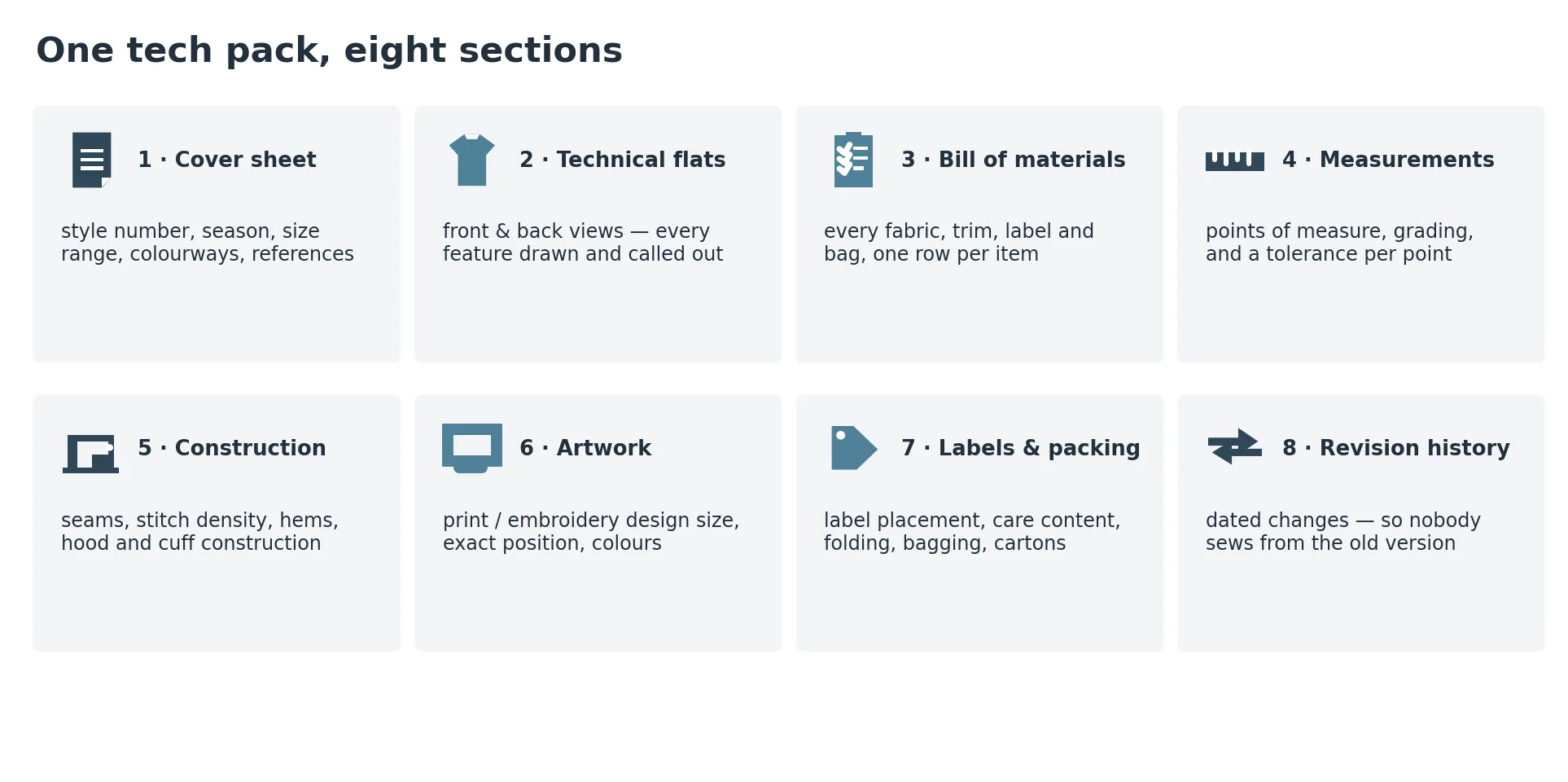
First, a distinction that saves confusion
A production brief tells the factory what you want to achieve — the product, the customer, the price neighbourhood, the references. A tech pack tells the factory exactly what to make. Think brief = the destination, tech pack = the map. If you’ve already written a brief, our production brief guide covers that half; this article is the map.
1. The cover sheet: what is this style?
Style name or number, product type, season, size range, colourways. One page that lets anyone in the building identify the style in three seconds. It sounds trivial until a factory is running forty styles and your sample gets somebody else’s ribbing. Reference photos or a mood image belong here too — clearly marked as reference, not spec.
2. Technical flats with callouts
Front, back and relevant side views of the garment, drawn flat — line drawings, not fashion illustrations — with callout lines naming every feature: pocket shape and position, hood construction, cuff and hem treatment, drawcord and eyelet details, where prints or embroidery sit. The flat is the factory’s picture of your intentions; anything not drawn or called out will be decided for you by someone holding scissors. Hand-drawn is acceptable. Ambiguous is not.
3. The bill of materials (BOM)
Every physical thing the garment is made of, listed: each fabric (what it is, its weight, its colour per colourway), ribbing and trims, drawcords, zips, buttons, elastic, thread, labels, hang tags, packaging. One row per item, with the supplier or spec for each. The BOM is where quotes become accurate — a factory pricing from a complete BOM is pricing your actual garment; a factory pricing from photos is pricing a guess, and the difference surfaces later, usually at your expense.
4. Measurements, grading and tolerances
A measurement chart: every point of measure (chest, body length, sleeve, shoulder, hood depth — whatever the garment has), the value for your base size, and how each point grades up and down across the size range. Two details separate useful charts from decorative ones. Define each point precisely — “chest 2.5 cm below the armhole, measured flat” — because two honest people will measure a hoodie differently if you don’t. And state a tolerance per point: the plus/minus band inside which a garment passes. No tolerance stated means every sample review becomes an argument about whether 0.7 cm matters.
5. Construction details
How it’s put together: seam types where they matter, stitch density, hem and cuff construction, how the hood is lined, how labels are attached, reinforcement at stress points. You don’t need a sewing degree — name the outcome (“hood lined in self fabric”, “flatlock-style seams on the body”) and let the factory’s technicians propose the method on the first sample if you’re unsure. What matters is that the decisions get written somewhere, so sample two and bulk production follow sample one’s corrected version, not a fresh interpretation.
6. Artwork: prints and embroidery, placed and measured
For every print or embroidery: the artwork file, its finished size in centimetres, its exact placement measured from fixed points (“centre chest, top of design 8 cm below the neck seam”), and its colours. “Logo on chest, roughly here” is how logos migrate. Which decoration method suits the design is its own decision — our screen printing vs DTG vs embroidery comparison walks through it — but whichever you choose, its size and position are tech-pack information, not sampling-stage surprises.
7. Labels and packaging
Your main label type and placement, care label content, hang tag spec, how each garment is folded and bagged, what’s in a carton. If you’re running a private label programme, this section is where it lives — the components themselves are covered in our private label walkthrough. Factories ask about labels late surprisingly often; a tech pack that answers early keeps your finishing line from waiting on a woven label.
8. Revision history
One small table: date, what changed, who approved it. Tech packs evolve across sampling rounds — measurements move, a pocket shifts — and the fastest way to produce a bulk run of the old version is to let an outdated file keep circulating. Version it, date it, and make the factory confirm they’re working from the current one. This section costs four minutes and has saved more orders than any other page in the document.
What “good enough” looks like for a small brand
You do not need specialist software. A spreadsheet for the BOM and measurements, a document for flats and callouts, artwork files attached — that is a working tech pack if the information is complete and unambiguous. Factories would rather receive an ugly pack that answers everything than a gorgeous one that leaves the sleeve length to interpretation. Completeness is the quality that counts, because every gap in the document comes back as a question, a delay, or a sample that isn’t what you meant — and sampling rounds are where young brands quietly burn their budgets.
Send the pack before you ask for the quote, keep it updated as samples teach you things, and treat the final approved version as part of the order itself. It is the cheapest insurance in the whole production process.
About Jiajia: Zaozhuang Jiajia Garment Co., Ltd. has made knit apparel in Shandong, China since 2005 — T-shirts, sweatshirts, hoodies, pajamas and loungewear for overseas brands and wholesalers. Working on a tech pack for a knit style? Send it over — we’ll read it the way our pattern room would and tell you what’s missing before it costs you a sampling round. Contact us
Let’s discuss your collection
Tell us what you are planning to make.