
Screen Printing vs DTG vs Embroidery: Which Should Your Design Use?
Every logo lands on a garment one of three ways, and each way fails differently. Screen printing can crack when it’s done cheaply. DTG can fade when the pre-treatment is rushed. Embroidery can pucker a lightweight tee into a small disaster. None of the three is “the quality one” — they’re tools with different physics, and the buyer’s job is matching the physics to the design.
Here’s how each actually works, what it does to the garment, and the cases where each one wins outright.
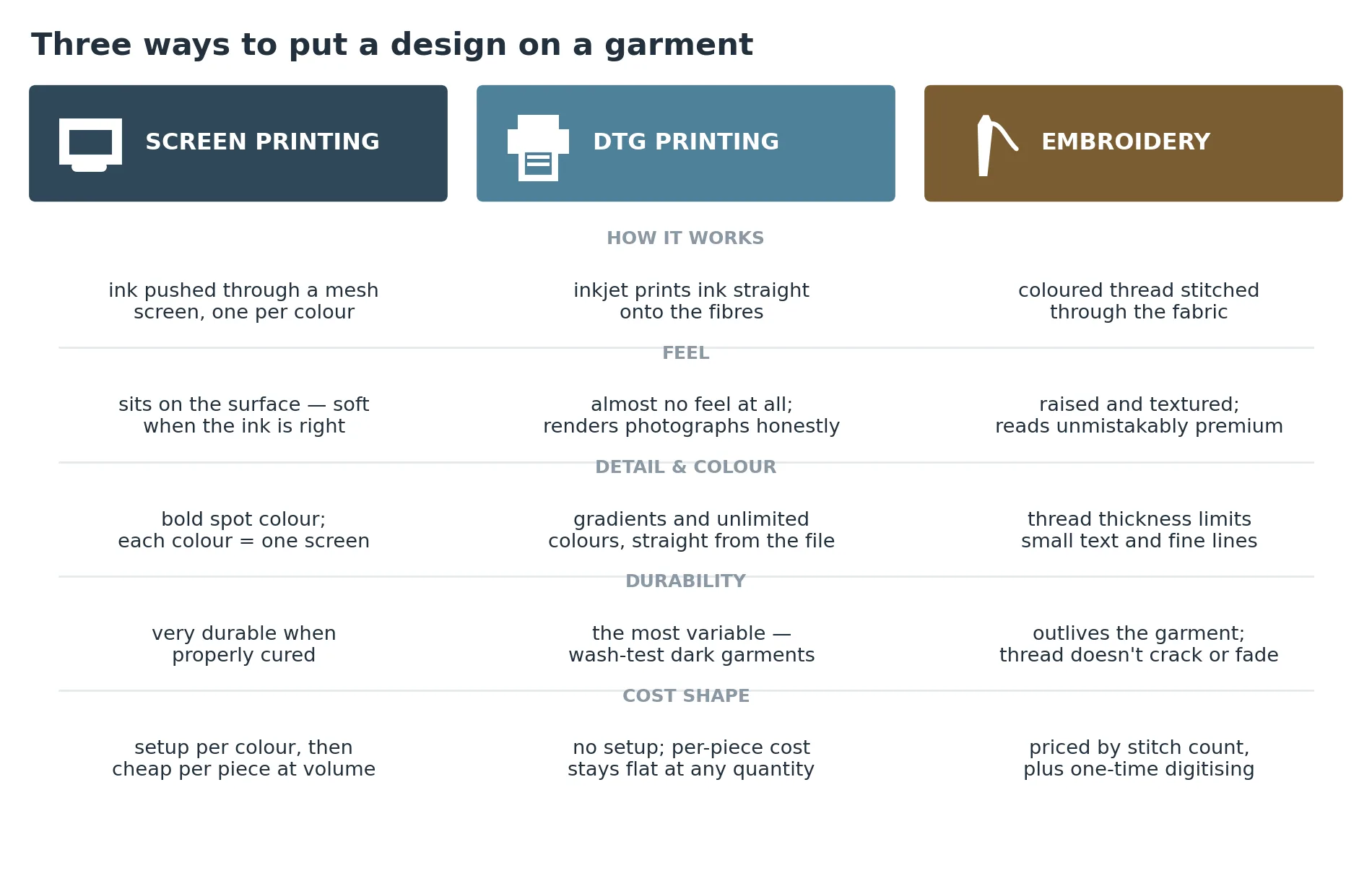
How each method puts a design on fabric
Screen printing pushes ink through a mesh screen, one screen per colour. Your design is separated into its colours, a screen is made for each, and the printer lays them down in sequence. Simple, century-old, and still the workhorse of garment decoration.
DTG (direct-to-garment) is an inkjet printer for clothes. The garment lies flat, the machine jets water-based ink straight onto the fibres, and the design can have as many colours and gradients as the artwork file holds. Dark garments need a pre-treatment layer first so the ink has something to sit on.
Embroidery doesn’t print at all — a machine stitches coloured thread through the fabric, following a digitised version of your artwork. The design is literally built out of thread, which is why it behaves so differently from the other two.
Hand feel and look
Screen printing sits on the surface. Done well with the right ink it can be soft and flexible; done heavily it turns into the stiff chest plate everyone has owned once. DTG feels like almost nothing — the ink is in the fibres, not on them — and it’s the only one of the three that renders a photograph honestly. Embroidery is raised, textured and unmistakably premium to the touch; it reads as “this brand spent money” before anyone reads the logo.
Detail and colour
DTG wins detail outright: gradients, shadows, forty colours, tiny tonal shifts — if it’s in the file, it’s on the shirt. Screen printing handles bold shapes and crisp spot colour beautifully, and fine detail is possible, but every colour is another screen, so a twelve-colour design is a production decision, not an afterthought. Embroidery is the most constrained: thread has thickness, so very small text blurs, thin lines break up, and gradients become stepped colour changes. A logo that will be embroidered usually needs a simplified version — and it’s better to learn that at the artwork stage than at the sample stage.
Durability
Embroidery outlives the garment. Thread doesn’t crack or fade in any normal wash life; when the shirt dies, the logo is usually still fine. A well-cured screen print is close behind — the failures people remember come from under-cured ink or prints so thick they flex and crack. DTG is the most variable: on light garments it’s respectable, on dark garments its wash life depends heavily on the pre-treatment and curing, and it’s the first of the three to soften and fade. None of this is a reason to avoid DTG — it’s a reason to wash-test your actual sample, hard, before bulk.
Which garments suit which method
Screen printing goes almost anywhere flat — tees, hoodies, sweatshirts, pajama sets — and its surface matters less than the fabric’s smoothness (our French terry vs fleece comparison covers which faces print cleanest). DTG is happiest on smooth, flat panels; heavy fleece texture and very dark colours demand more from it. Embroidery needs fabric with enough body to hold stitches without puckering — it thrives on hoodies, sweatshirts and polo-weight knits, and fights you on thin, stretchy tees unless the design is small and the backing is right.
The cost shape (this is the part that decides most orders)
Screen printing charges you up front — screens and setup per colour — then gets cheap per piece. DTG has almost no setup, but the per-piece cost stays roughly the same whether you print ten or ten thousand. Embroidery is priced by stitch count, which means by design size and density, plus a one-time digitising step.
That shapes the verdict more than quality arguments do: big runs of a fixed design pull hard toward screen printing; short runs, many colourways, and print-on-demand-style restocks pull toward DTG; and embroidery sits where it sits — you pay for thread and time because the result can’t be faked. Decoration is one line in the full cost picture, by the way; our clothing cost breakdown shows where it sits among the others.
The verdict, by case
Bold logo, serious quantity, one design: screen printing. It’s not close.
Photographic art, gradients, small runs, many designs: DTG — and wash-test the sample like you mean it.
Chest logo, premium positioning, workwear or club feel: embroidery, with a stitch-friendly version of the artwork.
And whatever you choose: approve the decoration on the pre-production sample, on the real garment, in the real fabric — not on a screen mock-up or a printer’s test square. How decoration survives the jump from sample to bulk is its own topic, and it’s the one that decides whether this choice still looks right at piece five hundred.
About Jiajia: Zaozhuang Jiajia Garment Co., Ltd. has made knit apparel in Shandong, China since 2005 — T-shirts, sweatshirts, hoodies, pajamas and loungewear for overseas brands and wholesalers. Send us your artwork and the garment it’s going on, and we’ll tell you honestly which of the three we’d use, and what we’d watch out for. Contact us
Let’s discuss your collection
Tell us what you are planning to make.