
Clothing Label Requirements by Country: Why One Label Rarely Fits All Markets
The garment is identical. The box it ships in is identical. But the small label in the side seam has to change its contents — sometimes its language — depending on which country’s shelf it lands on. Brands usually discover this in the worst order: after the labels are woven, sometimes after the goods are sewn, occasionally after customs has questions.
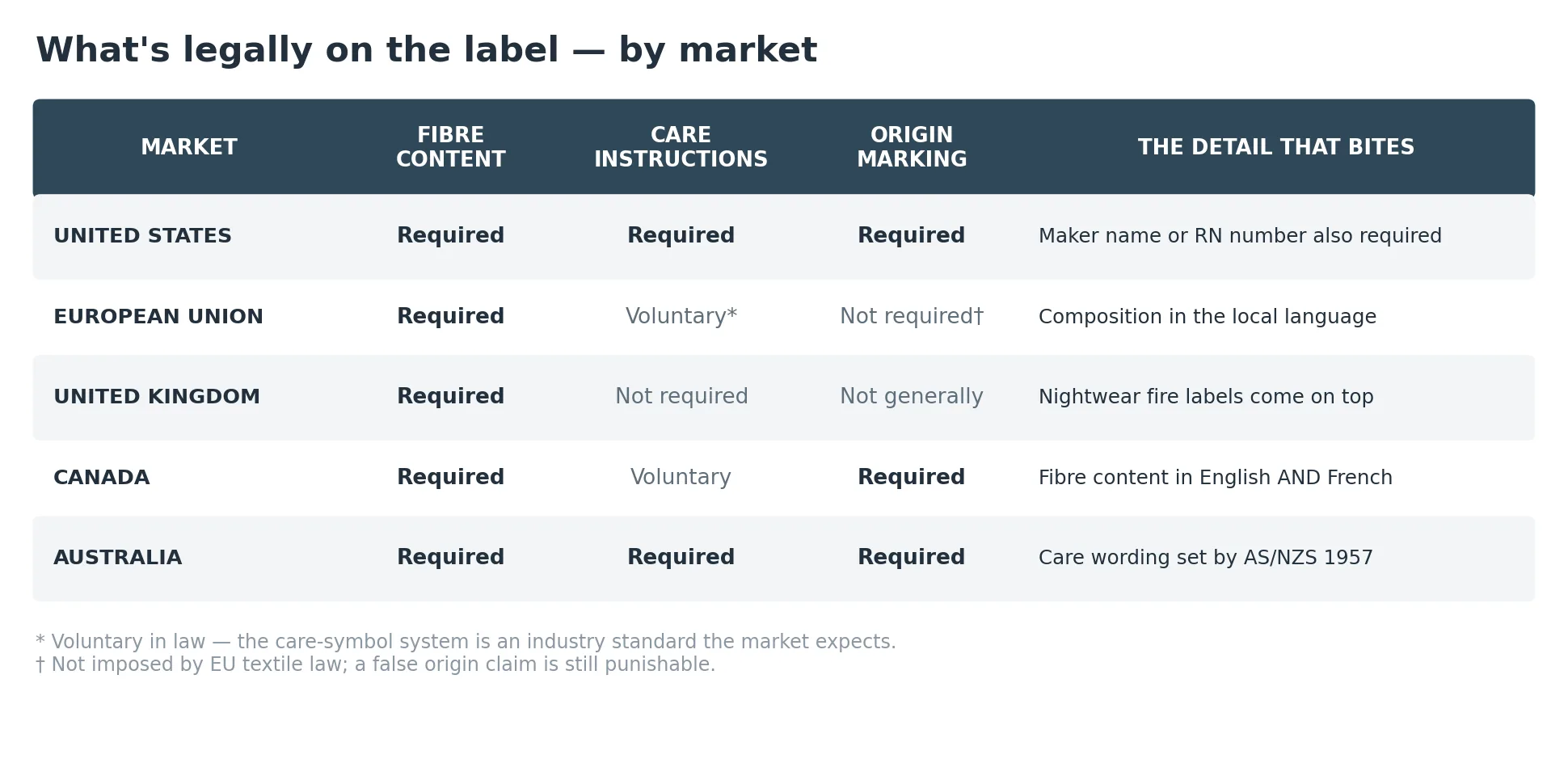
Label law is unglamorous and absolutely rigid, and it differs by market in ways that aren’t intuitive. One major market doesn’t legally require care instructions at all. Another prescribes care labelling down to the wording. A third wants your fibre content in two languages. Here’s the side-by-side picture for the five markets most knitwear brands sell into — the orientation version, to be confirmed against your exact product before production, because “label” rules also carry product-specific corners (children’s nightwear fire labels, for instance, are their own regime, covered in our children’s sleepwear compliance guide).
United States: the full set, federally prescribed
The US asks for the most on one label. Under the FTC’s textile rules, a garment label must carry: the fibre content by generic fibre name and percentage, in descending order; the manufacturer’s name or the registered identification number (RN) issued to the company; and the country of origin. Care instructions are separately mandatory under the Care Labeling Rule — either written instructions or the standard ASTM care symbols — and they must be complete enough that following them won’t damage the garment. If your garment needs a warning for one of the treatments (do not bleach, do not iron), the label has to say that too.
European Union: fibre composition is law, care is custom
EU law (Regulation 1007/2011) is strict about exactly one thing: fibre composition. Only approved fibre names may be used, percentages follow prescribed rules, and the composition must appear in the official language of the member state where the garment is sold — which is how a single EU range ends up with a small booklet of a label. What surprises most newcomers: care labelling is not required by EU law. The familiar row of care symbols is a voluntary industry system (the symbols are a registered trademark, licensed through GINETEX and its national bodies) that the market expects even though the law doesn’t. Origin marking is likewise not imposed by the EU textile rules themselves — “Made in” appears because buyers and brands want it, and because other laws punish a false one.
United Kingdom: the EU fibre rules, kept
The UK kept the fibre-composition regime in its own regulations after Brexit, so fibre content labelling works much as it does in the EU. Care labelling is not a legal requirement in the UK either — it is, however, near-universal trade practice, and returns desks will treat a missing care label as a defect even if the law doesn’t. The UK’s distinctive label burden is not on the care label at all; it’s the flammability labelling on nightwear under the Nightwear (Safety) Regulations, which sits on top of ordinary labelling for that category.
Canada: everything twice, in two languages
Canada’s Textile Labelling Act requires fibre content to be declared in both English and French — the single most common labelling failure for brands entering Canada, who arrive with an English-only label that was perfectly legal everywhere else they sell. The label must also identify the dealer (the business responsible for the product in Canada) by name and postal address, or by its registered CA identification number. Care labelling in Canada is voluntary — but if you provide it, it has its own national standard of symbols and bilingual wording to follow. Imported garments additionally need country-of-origin marking under Canada’s customs marking rules.
Australia: care labelling with prescribed wording
Australia mandates more of the label than most. Fibre content must be declared. Country of origin must appear on imported clothing. And care labelling is compulsory under a dedicated standard (AS/NZS 1957): instructions must be given in the prescribed form — the standard’s symbols and wording — and they must be instructions the garment can actually survive. Brands used to writing any plausible care text discover that in Australia the text is effectively a regulated document.
What this means when you plan production
Practically, three things. Budget for market-specific label sets. One universal label rarely survives contact with all five regimes — bilingual Canada alone breaks it — so labels get planned per destination, early, alongside the rest of the private label programme rather than after it. The composition on the label is a legal statement, not marketing copy. Percentages and fibre names must match what the garment actually is and what the testing says; a wishful label is a customs and liability problem, not a branding flourish. And sequence the artwork accordingly: label production runs ahead of garment finishing, so a new market’s label requirements belong in the tech pack and the order paperwork at the start — the cheapest moment to learn that Canada wants French is before ten thousand labels exist in English only.
About Jiajia: Zaozhuang Jiajia Garment Co., Ltd. has made knit apparel in Shandong, China since 2005 — T-shirts, sweatshirts, hoodies, pajamas, loungewear and children’s knitwear for brands selling into the US, Europe, the UK, Australia and beyond. Planning a range for more than one market? Send us your destination list, and we’ll flag the label sets each market will need, as part of mapping your labels, tags and packaging programme. Contact us.
Note: general orientation only, based on the labelling regimes as published at the time of writing. Requirements vary by product and change over time — confirm your exact label content with your importer of record or compliance advisor before labels are produced.
Let’s discuss your collection
Tell us what you are planning to make.