
Children’s Sleepwear Compliance Basics: The Rules That Shape the Garment
Adults’ pajamas are among the least regulated garments in the world. Children’s pajamas are among the most. The reason is grim and simple: loose sleepwear, open flames and small children were a combination regulators decided to engineer out of existence — and they did it not with suggestions but with flammability law that reaches all the way back into your pattern drafting.
If you sell children’s sleepwear into the US, EU, UK or Australia, compliance isn’t a label you add at the end. It chooses your fit, your trims, sometimes your fabric, and it generates paperwork that must exist before customs will let the goods in. This is the map of it, in plain terms. It is orientation for planning, not legal advice — the confirming word always belongs to an accredited testing laboratory, market by market, before production.
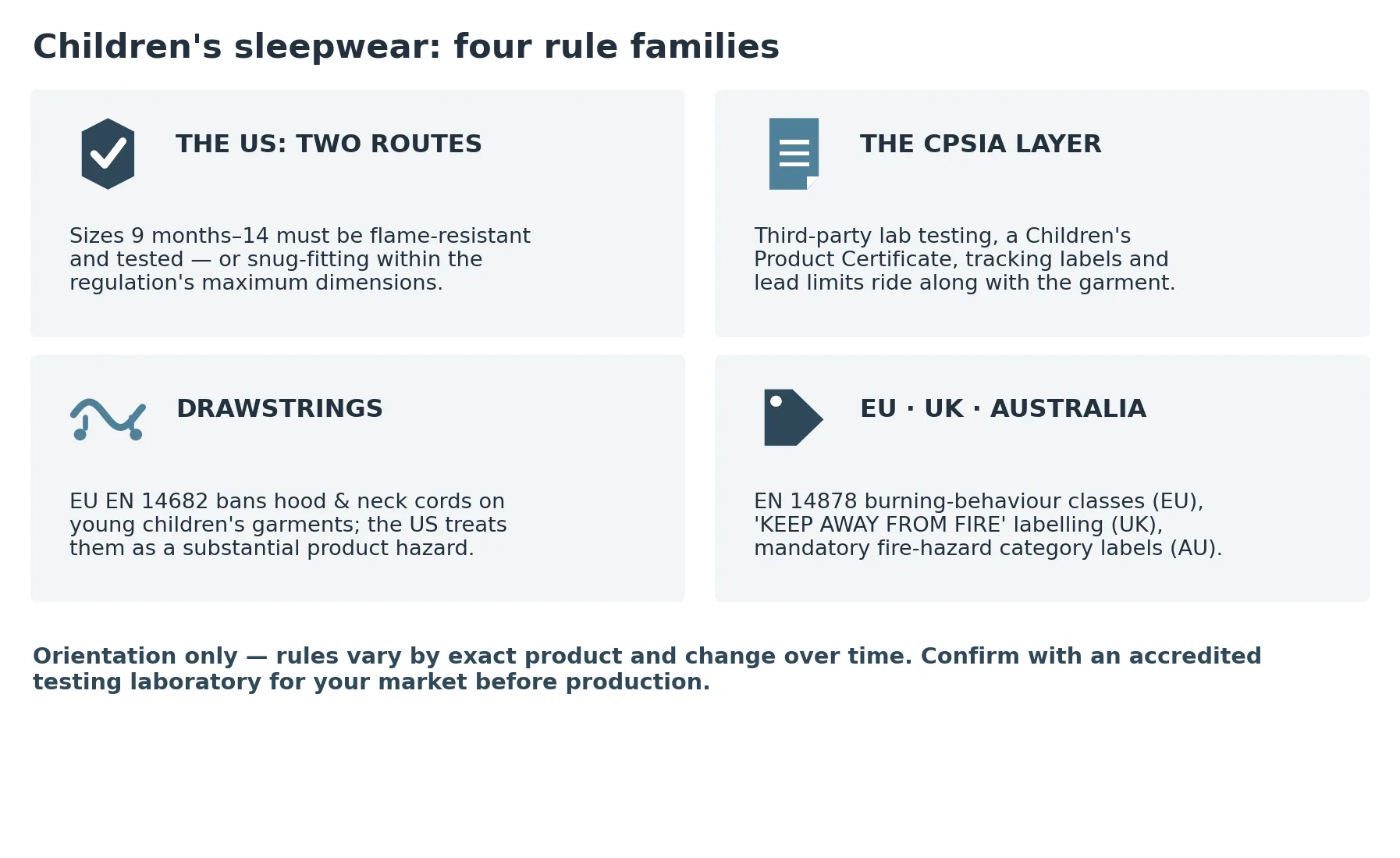
The United States: two routes, and you must take one
US children’s sleepwear in sizes 9 months through 14 is governed by two federal standards — 16 CFR Part 1615 (sizes 0–6X) and Part 1616 (sizes 7–14). Every garment in scope must qualify by one of two routes.
Route one: flame-resistant. The fabric and garment pass the standard’s flammability test — in essence, the material must resist sustained burning when exposed to a small flame, tested at the fabric stage and again as finished garments, and keep passing through production. Some fabrics do this by their nature; others need treatment. Either way, it’s a testing programme, not a hope.
Route two: snug-fitting. The garment is exempt from the flammability test if it fits tightly enough, by measurement. The regulation sets maximum dimensions for the chest, waist, seat and limbs at every size, with sleeves and legs tapering toward the wrist and ankle, and limits on how far trim can stand off the surface. This is why so many children’s pajamas fit close: the fit is the compliance. Snug-fit garments must carry the prescribed warning wording on their labelling — the customer has to be told the garment should fit snugly and is not flame resistant.
Two carve-outs worth knowing: garments sized 9 months and under are exempt from the sleepwear standards (a general flammability standard for clothing still applies), and “sleepwear” is judged by what the garment is and how it’s sold — market a garment as pajamas and the rules follow the marketing, whatever the tech pack calls it.
The wider US layer: CPSIA
Sleepwear rules sit inside a broader children’s-product law, the CPSIA. For garments it adds three things brands must organise. Third-party testing by a CPSC-accepted laboratory for the applicable rules. A Children’s Product Certificate — a document the importer issues, certifying compliance on the basis of those test results, which accompanies the shipment. And tracking labels on the product, so any garment can be traced back to its production run. Chemical limits ride along too: total lead in children’s products is capped, and phthalate limits apply to sleepwear for the youngest children, which US law treats as a childcare article. None of this is optional paperwork; it’s the cost of the category.
Drawstrings: the rule that redesigns hoodies
Separate from fire, every major market restricts cords and drawstrings on children’s clothing, because cords catch on playground equipment, bus doors and escalators. In the EU, standard EN 14682 bans drawstrings and functional cords in the hood and neck area of young children’s garments entirely, and tightly limits cord lengths and finishes elsewhere. The US treats hood and neck drawstrings on children’s upper outerwear as a substantial product hazard, with the ASTM F1816 specification setting the accepted dimensions for waist and bottom drawstrings instead. The practical consequence lands at design stage: the drawstring hoodie your adults’ range lives in does not transfer to the children’s version. The kids’ version is a different design, not a smaller copy — a point that matters even more in family matching ranges, which we cover in our production planning guide for matching pajama sets.
Europe and the UK: burning behaviour and warning labels
The EU addresses children’s nightwear burning behaviour through EN 14878, which classifies garments by how flame spreads across them — nightdresses and similar loose garments face stricter expectations than pyjamas — and sits inside the EU’s general product-safety framework, chemicals included (REACH restrictions apply to children’s garments as to everything else). The UK runs its own Nightwear (Safety) Regulations: certain children’s nightwear must meet the BS 5722 flammability performance, pyjamas take a labelling route centred on a prominent red “KEEP AWAY FROM FIRE” warning unless they meet the standard, and adult nightwear carries flammability labelling too. Australia is the strictest labeller of the group: children’s nightwear sizes 00–14 falls under a mandatory standard built on AS/NZS 1249, garments are classified by fire hazard, and each must carry its category label — some garments are simply too flammable to be sold as nightwear at all.
What this means at the factory end
Three working consequences, whichever markets you sell into. Design for the rule first: if the plan is snug-fit, the pattern block, the size grading and the trim choices all have to be built to the regulated dimensions — you cannot retrofit compliance onto a loose design with a hangtag. Test the actual production fabric and the actual garment, through an accredited lab, on the market’s current version of the standard, and keep the reports with the shipment documents: certificates and tracking information are part of the product. And run your labelling as a compliance task, not a design task — snug-fit warnings, fire labels and the country-by-country label content each have prescribed forms, which is why label requirements get their own article in this series.
Children’s sleepwear rewards brands that treat the rulebook as a design brief. The ones who struggle are the ones who meet it at the shipping stage.
About Jiajia: Zaozhuang Jiajia Garment Co., Ltd. has made knit apparel in Shandong, China since 2005 — including children’s pajamas, nightdresses and knitwear for overseas brands and wholesalers. Planning a children’s sleepwear range? Send us the markets you’re selling into and the styles you have in mind, and we’ll talk through how the designs would be built for those rules — patterns, fits and labelling — before anyone cuts fabric. Contact us.
Note: this article is a general overview for planning purposes, based on the standards as published at the time of writing. Regulations change, and requirements vary by exact product and market. Always confirm your specific case with an accredited testing laboratory or compliance advisor before production.
Let’s discuss your collection
Tell us what you are planning to make.