
How Long Does Clothing Manufacturing Take? The Stages Behind the Schedule
“How long will my order take?” is the most natural question in sourcing, and the least answerable in one number. Not because factories are evasive — because production isn’t one activity. It’s a chain of stages in different buildings, run by different companies, and the chain moves at the speed of its slowest link that month.
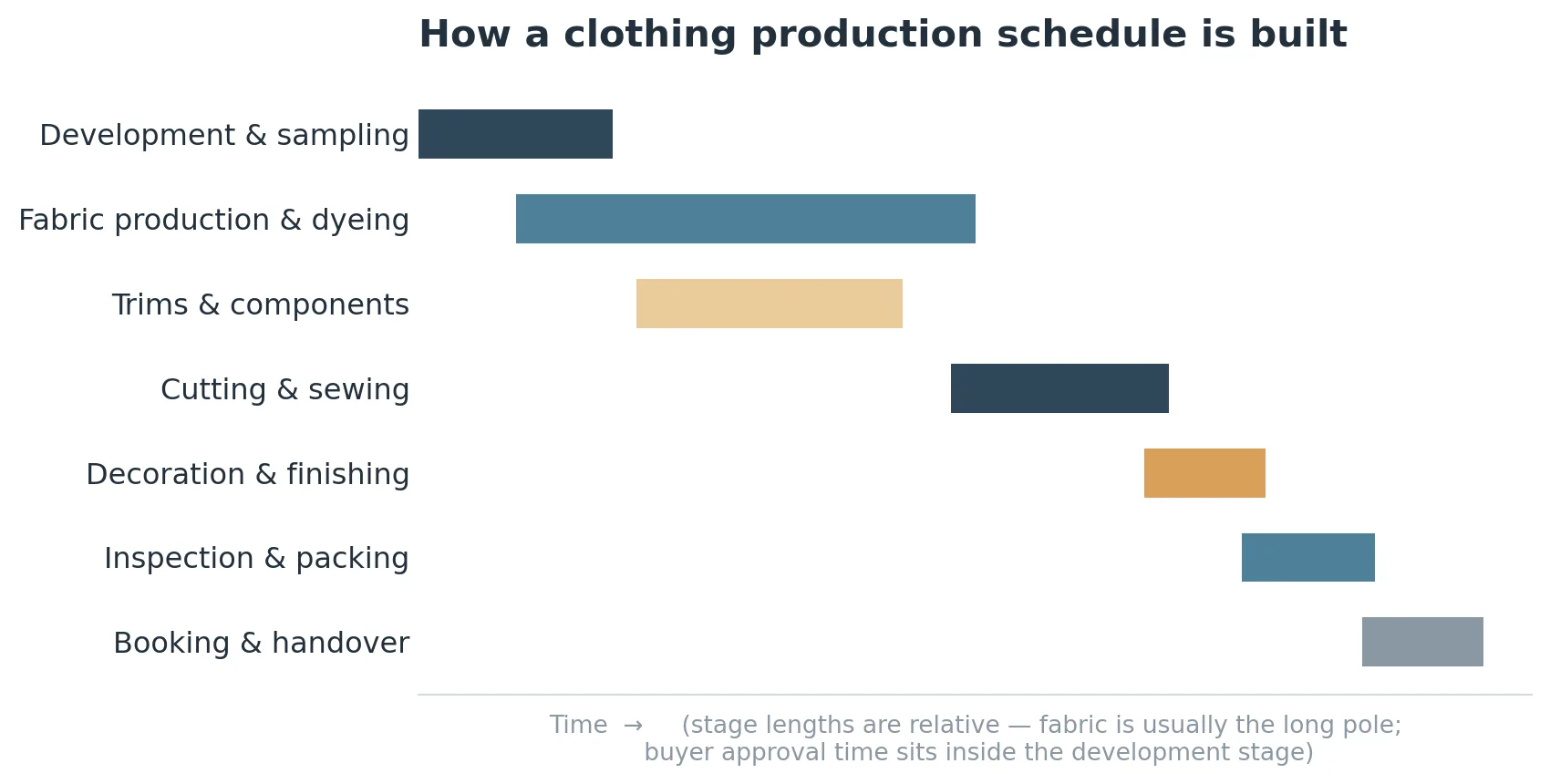
Plan with the chain in view and schedules stop being mysterious. Here it is, link by link, with the part nobody tells you: where the time actually hides.
Stage 1: Development and sampling
Before production can even be scheduled, the garment has to exist as an approved sample — pattern made, fit checked, construction agreed. How long this takes depends less on the factory than on the loop: how complete your specification was at the start (a solid production brief shortens everything downstream), how many revision rounds the garment needs, and how fast approvals come back. Notice that last variable. It’s yours. A week spent waiting for a fit comment is a week on the schedule, and it belongs to the buyer’s desk, not the factory’s floor.
Stage 2: Fabric — usually the long pole
Fabric is produced to order more often than buyers expect. Weaving or knitting the cloth, then dyeing it to your colour, then finishing it, happens at a mill on the mill’s schedule — and your factory is in that queue like everyone else. Custom colours and specially finished fabrics extend this stage; stock fabric can shrink it dramatically, sometimes to the time it takes to deliver. When a production schedule slips before a single garment is sewn, this stage is the usual reason. It’s also the stage buyers can influence earliest: approving colours and lab dips promptly, and deciding stock-versus-custom with the calendar in mind.
Stage 3: Trims and components
Labels, tags, zips, elastic, packaging — each is a small order at another supplier, running in parallel with the fabric, and each can become the bottleneck precisely because it looked too small to worry about. A garment cannot finish without its labels. Experienced factories order trims the moment the spec is locked; experienced buyers lock it early.
Stage 4: Cutting and sewing — the stage everyone pictures
This is the factory floor part, and it’s more predictable than the stages before it. Time here is driven by quantity, by construction complexity (a basic tee and a lined, pocketed hoodie are different animals on a line), and by how many lines the factory can put on your order. One honest complication: your order joins a queue. In peak season, the queue itself is a stage. Scheduling early in the season cycle is worth as much as any negotiation.
Stage 5: Decoration, finishing, inspection
Printing or embroidery, thread trimming, pressing, final inspection against the agreed standard, folding and packing. Mostly days-scale work, but inspection has a property buyers forget: if it finds a problem, production goes backwards. The schedule protection isn’t rushing this stage — it’s the in-line checks earlier that keep the final one boring.
Stage 6: Packing, booking, handover
Cartons, documents, booking freight, delivery to the port or consolidator. Partly paperwork, and paperwork has its own pace. This stage ends at handover — what happens on the water or in the air belongs to the shipping plan, not the factory schedule, and the two should never be confused when you’re counting backwards from a launch date.
The clock nobody counts
Add the stages honestly and most schedule pain comes from three places: fabric, the queue, and waiting — samples waiting for comments, colours waiting for approval, specs waiting to be locked. Two of the three are influenced more by the buyer than the factory, which is quietly good news: the biggest schedule lever you own is decision speed.
Work backwards from your selling date. Shipping first, then production stages, then development — and put your own approval steps on the calendar with dates, like any other supplier’s. The brands that never miss a season aren’t the ones whose factories are fastest. They’re the ones whose chain has no silent weeks in it.
About Jiajia: Zaozhuang Jiajia Garment Co., Ltd. has produced knit apparel in Shandong, China since 2005 — T-shirts, sweatshirts, pajamas, loungewear and children’s knitwear for overseas brands and wholesalers. Planning a season? Send us your target date with your specification, and we’ll map the stages against it honestly — including the ones that depend on you. Contact us
Let’s discuss your collection
Tell us what you are planning to make.