OEM vs ODM vs Private Label vs White Label: Four Terms That Aren’t a Ladder
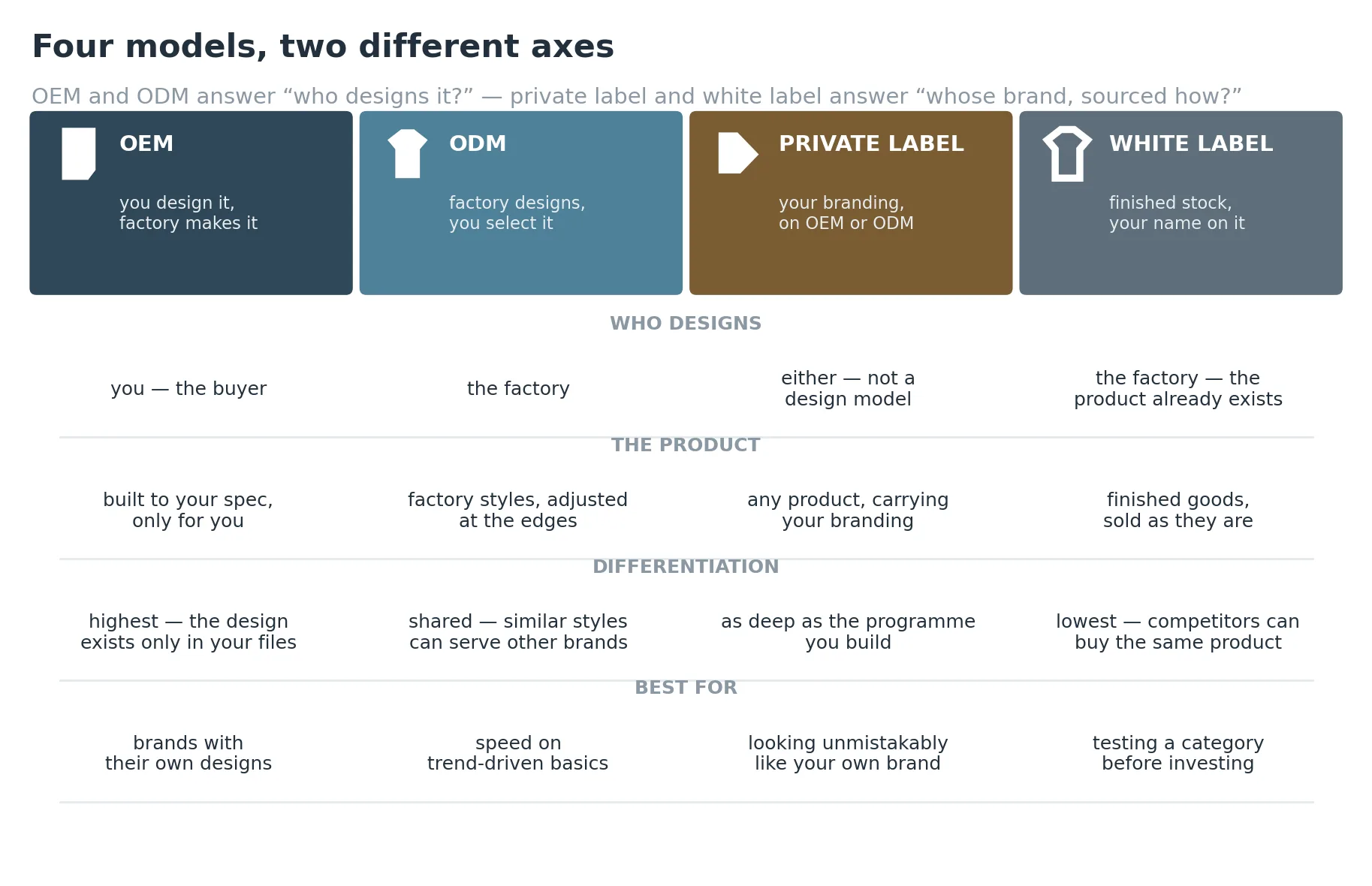
Ask four suppliers what “private label” means and you’ll get four answers, two of them contradictory. The confusion isn’t carelessness — it’s that these four terms were never one scale. OEM and ODM describe who designs the product. Private label and white label describe whose brand goes on it, and how the product was sourced. Once you see the two axes, the terms stop fighting each other, and you can combine them on purpose instead of by accident.
Here’s each model as it actually works in clothing, and which brands each one fits.
OEM: you design it, the factory makes it
In an OEM arrangement, the design is yours. You arrive with the product defined — drawings, measurements, fabric direction, construction details — and the factory’s job is to execute it faithfully: source the materials, build the samples, run production to your spec.
You own the design and the decisions; the factory owns the making. That gives you the most control and the most differentiation — nobody else can sell your exact garment, because it exists only in your files. The price of that control is development work: somebody has to produce a proper spec, review samples and make decisions at every stage. Brands with a designer, or a founder who can work from reference garments and measurements, live here naturally.
ODM: the factory designs it, you select and brand it
ODM flips the first axis. The factory develops styles itself — its own patterns, its own fabric choices, a catalogue or showroom of ready designs — and you select from what exists, adjusting details at the edges: colours, prints, trims, your branding.
Development is faster and cheaper because the expensive part (creating and testing the style) is already done. The trade is exclusivity: the base style belongs to the factory, and a similar garment can legitimately appear under other brands. For trend-driven basics where speed matters more than uniqueness, that’s often a fair trade — the market rarely rewards a plain hoodie for being one of a kind. For a signature product your brand will be known by, it’s a weaker foundation.
Private label: your brand, applied properly
Private label isn’t a design model at all — it’s the branding layer, and it can sit on top of either OEM or ODM. Your brand’s labels, tags and packaging go onto the product: the woven label in the neck, the care label in the side seam, the hang tag, the bag or box it ships in. The garment underneath might be your own design (OEM) or a factory style (ODM); private label is what makes it unmistakably yours on the rail and in the customer’s hands.
This is why “do you do private label?” is the wrong first question — almost every export factory will say yes, and they mean wildly different depths of it, from sewing in a label you supply to running the whole branding programme for you. What a private label programme actually includes — each component, and the artwork process behind it — deserves its own walkthrough, and we’ve written one.
White label: finished goods, your name, minimal changes
White label sits at the far end of the effort spectrum: the product already exists — often as ready stock — unbranded or generically branded, and you apply your label with little or no change to the product itself. No development, no sampling rounds, no waiting on production; you are buying finished goods and branding them.
Used honestly, white label is a legitimate tool: testing a new category, filling a gap in a range, learning what your customers buy before you invest in development. The risk is building a brand on products that a dozen competitors can buy identically — differentiation has to come from somewhere else: your marketing, your service, your eye for selection.
The two axes, on one page
Who designs it? OEM — you do. ODM — the factory did. White label — the factory did, and finished it too.
Whose brand, how deep? White label — your label on a stock product. Private label — your full branding programme, on an OEM or ODM product.
Most real arrangements are combinations: ODM styles with a full private label programme is how many young brands launch; OEM with private label is where they usually migrate once their own designs start selling. The question to answer first isn’t “which label do we want” — it’s “how much design work is ours, honestly, this season?” The rest follows.
Whichever route you’re weighing, the partner question matters as much as the model: a factory that runs both OEM and ODM work will tell you plainly which of your styles suits which route. If you’re mapping your first collection, our manufacturing services page lays out how we run both, and the branding programme behind them.
About Jiajia: Zaozhuang Jiajia Garment Co., Ltd. has made knit apparel in Shandong, China since 2005 — OEM and ODM production with private label branding for overseas brands and wholesalers, across T-shirts, sweatshirts, hoodies, pajamas and loungewear. Tell us where your designs stand — finished specs, rough ideas, or none yet — and we’ll tell you which model fits, honestly, even if the answer is “start simpler than you planned.” Contact us
Let’s discuss your collection
Tell us what you are planning to make.