What Does Private Label Clothing Actually Include? The Full Component List
“We do private label” can mean anything from we’ll sew in a label if you send us some to a complete branding programme where your garment arrives retail-ready in your bag with your tag on it. Both factories are telling the truth as they see it. The difference lives in the component list — so here it is, piece by piece, with what your factory needs from you for each.
If you haven’t yet sorted out how private label relates to OEM and ODM, start with our model comparison — this article assumes the branding layer is what you’re building.
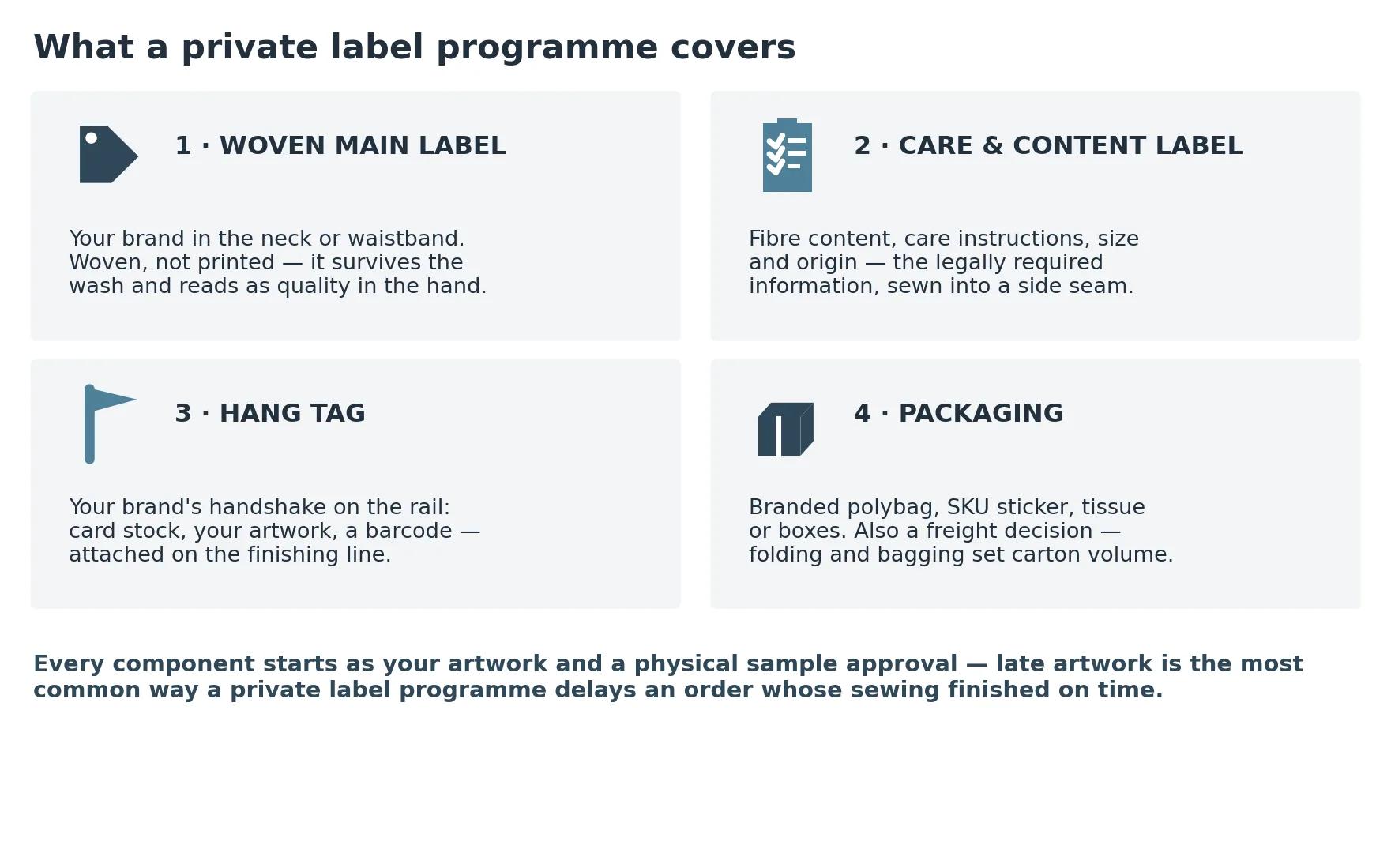
1. The woven main label
The label in the neck or waistband carrying your brand name — the single most recognised piece of the programme. Usually woven rather than printed, because weaving survives washing and reads as quality in the hand. You’ll decide size, colours, fold style and placement (centre neck, side seam, hem). What the factory needs from you: your logo artwork in a proper file, the exact wording, and approval of a physical label sample — woven labels are made by specialist label makers, and a colour that looked right on screen can weave up differently.
2. The care and content label
The unglamorous label that carries the legally required information: fibre content, care instructions, size, country of origin, and in many markets a manufacturer or importer identification. It usually sits in a side seam where nobody admires it and inspectors look first. Two things buyers get wrong: treating its content as a design choice (it isn’t — the information must be accurate and complete for the market you’re selling into), and approving it late, even though it’s produced alongside the main label and sewn in during production, not after.
3. The hang tag
Your brand’s handshake on the rail. Card stock, your artwork, usually a barcode or price sticker added at your end or applied per your instruction. The hang tag is where brands most often overspend early (heavy boards, strings, seals) or underspend forever (a flimsy tag on a premium garment quietly arguing with the price). What the factory needs: print-ready artwork and a decision on attachment — string, pin, or looped through a label — because that choice is made on the finishing line, garment by garment.
4. Packaging
At minimum, the individual polybag most garments travel in — which can carry your branding, a warning text where your market requires one, and a SKU barcode sticker. Beyond that, the ladder climbs: branded bags, tissue and stickers, boxes, sets folded and banded together. Packaging decisions are also logistics decisions — how a garment is folded and bagged changes carton sizes and freight volume, so this component belongs in the cost conversation, not just the brand conversation.
What sits around the components
Printed or embroidered branding on the garment itself — a chest logo, a sleeve print — is decoration rather than labelling, and it runs through the printing decision, not the label programme. Keep the two apart in your planning and your budget; they involve different suppliers inside the factory and different approval samples.
The artwork process is the invisible component. Every piece above starts as your files, becomes a physical sample, and waits on your approval. The programme runs at the speed of those approvals: labels are produced before or alongside your garments, and a garment cannot be finished, tagged or bagged around a label that doesn’t exist yet. Late artwork is the most common way private label programmes delay an order — the sewing finishes on schedule and then everything waits on a two-centimetre label.
Leftovers and repeats. Labels and tags are produced in batches and the surplus is normally held for your next order — worth confirming, because it makes reorders faster and keeps your branding consistent across seasons. And confirm who holds the artwork and the label stock if you ever move factories; your brand assets should be portable.
A one-paragraph checklist to send any factory
Ask, in writing: which components are included and which are priced separately; whether label sampling is part of sample development; what file formats they want; when artwork must be final relative to production; and how surplus labels are stored. A factory that runs private label programmes daily will answer all five without blinking — it’s the same ground we cover on our labels, tags and packaging service page. The ones who hesitate are telling you the programme is improvised, and improvised branding shows on the garment.
About Jiajia: Zaozhuang Jiajia Garment Co., Ltd. has made knit apparel in Shandong, China since 2005 — T-shirts, sweatshirts, hoodies, pajamas and loungewear with private label programmes for overseas brands and wholesalers. Send us your logo and the garments you’re planning, and we’ll map out the label, tag and packaging programme for them — components, artwork, timing — before you commit to an order. Contact us
Let’s discuss your collection
Tell us what you are planning to make.