
What GSM Is Best for a Hoodie? A Plain Guide to Fabric Weight
Somewhere in your first hoodie enquiry, a factory will ask: “What GSM?” And if you don’t have an answer, they’ll choose for you — usually whatever their standard fabric happens to be, which may or may not be the hoodie you were imagining.
GSM is simply fabric weight: grams per square metre. (Our GSM explainer covers how it’s measured and how to convert it to ounces.) What it decides in practice is how the hoodie feels in the hand, how warm it is, how it drapes, and a good slice of what it costs. Here’s the map buyers actually navigate by.
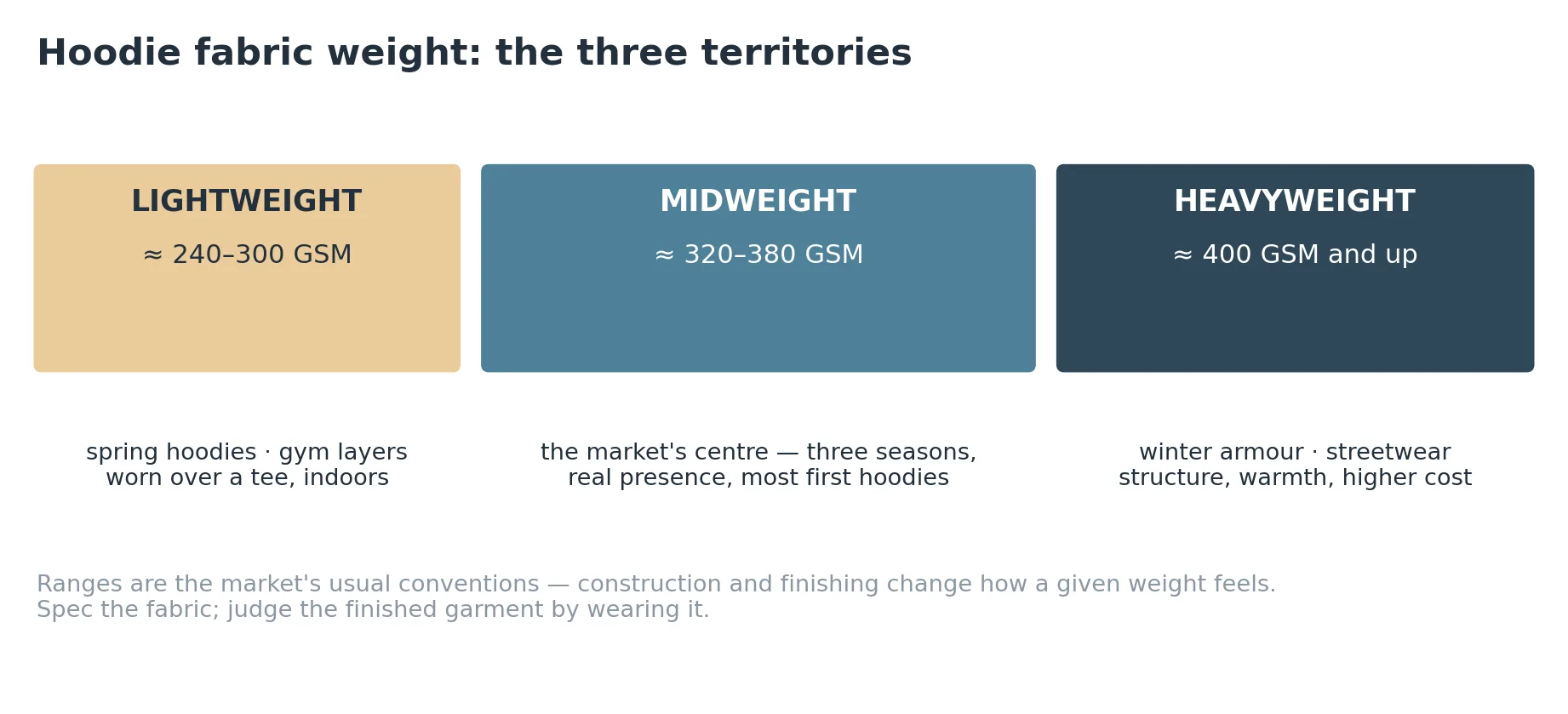
The three territories
Lightweight — roughly 240–300 GSM. This is the spring hoodie, the gym layer, the one worn over a tee indoors. It feels soft and easy, drapes close to the body, and packs small. In French terry this range is the classic warm-season sweatshirt weight. What it won’t do: feel premium-substantial, or keep anyone warm in November. Brands get into trouble here by speccing lightweight fabric for a garment whose photos promise a chunky hoodie — the fabric arrives exactly as ordered and still disappoints.
Midweight — roughly 320–380 GSM. The centre of the market, and for most brands the right answer. A midweight hoodie has real presence in the hand, holds its shape at the hood and kangaroo pocket, works across three seasons, and survives printing and embroidery beautifully. If you’re launching one hoodie and your customer isn’t a mountaineer or a beach shop, start here. Most of the hoodies people describe as “good quality” without knowing why live in this band.
Heavyweight — roughly 400 GSM and up. The winter armour: dense, warm, structured, with the stiff drape that streetwear brands prize. Heavyweight fabric costs more (you’re buying more material per garment — fabric is the largest line in any quote), sews slower, and ships heavier, which your freight bill will notice. It also photographs magnificently and feels like a promise. Choose it because your market and price point call for it, not because heavier sounds better in a meeting.
Weight is only half the decision
Two fabrics at identical GSM can produce different hoodies. Construction is the other half: a 340 GSM French terry and a 340 GSM brushed fleece differ in warmth, drape and surface — our French terry vs fleece comparison walks through it. Yarn quality and finishing matter just as much; a well-finished 320 can outfeel a sloppy 360. GSM is the spec you can write in an email, which is why it gets all the attention. Treat it as the starting point of the fabric conversation, not the whole conversation.
How to spec yours, practically
Work backwards from the wearing occasion. Who wears this hoodie, in what month, over what, at what retail price? Those four answers land you in one of the three territories almost every time.
Then sample at the edges of your territory, not just the centre. If you’re targeting midweight, feel a 320 and a 380 in your actual construction before you commit — the difference in hand is bigger than the numbers suggest, and the sample round is the cheapest place to learn it.
One last trap: GSM is a fabric spec, not a finished-garment weight. Buyers occasionally weigh a finished hoodie, divide by its area, and panic. Ribbing, drawcords, zips and double-layer hoods all add garment weight that has nothing to do with the fabric’s GSM. Spec the fabric; judge the garment by wearing it.
The short answer
Launching your first hoodie for a general market? Spec midweight, around the middle of the 320–380 band, in the construction that matches your season — and let the samples argue with you. There’s no universally “best” GSM. There’s a best GSM for a specific hoodie, sold to a specific person, in a specific month — and now you know how to find it.
About Jiajia: Zaozhuang Jiajia Garment Co., Ltd. has made knit apparel in Shandong, China since 2005 — T-shirts, sweatshirts, hoodies, pajamas and loungewear for overseas brands and wholesalers. Not sure which weight your hoodie should be? Send us the style and where it will be sold, and we’ll sample the weights we’d recommend — the argument is easier with fabric in your hands. Contact us
Let’s discuss your collection
Tell us what you are planning to make.