
French Terry vs Fleece: What’s the Difference, and Which Should Your Garment Use?
Order a sample in French terry and the “same” sample in brushed fleece, and you’ll hold two garments that look like cousins and behave like strangers. One drapes, breathes and feels cool against the skin. The other traps warmth, feels plush, and turns a plain hoodie into winter armour.
Both start life as loopback knit. The difference is one finishing step — and it changes almost everything about the finished garment. If you’re speccing sweatshirts, hoodies, sweatpants or loungewear, this choice quietly decides your season, your price point and half your returns. Here’s how to make it on purpose.
The one-step difference
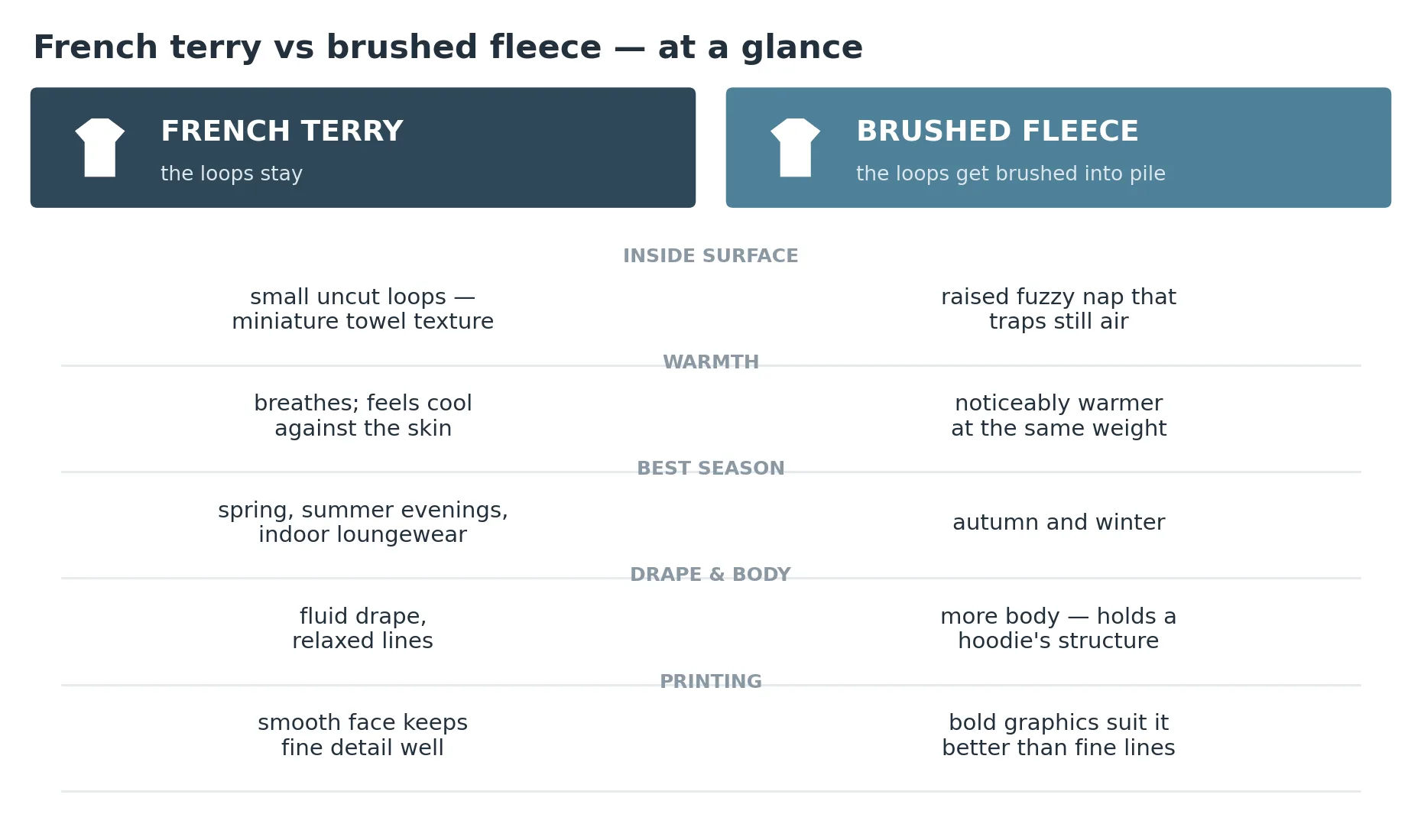
French terry keeps the loops. On the back of the fabric, the yarn sits in small uncut loops — the same construction as a towel, in miniature. The face is smooth; the back is textured, absorbent and airy.
Brushed fleece takes that same loopback fabric and runs it through a brushing machine, which tears and raises the loops into a fuzzy, napped surface. That raised pile is what traps air — and trapped air is insulation. Same base fabric in, two different materials out.
Warmth and season
This is the headline difference. Brushed fleece is noticeably warmer at the same weight, because the pile holds still air against the body. French terry breathes better and feels cool on the skin, which is why it owns spring, summer evenings and indoor loungewear.
Rule of thumb buyers actually use: French terry for transitional and warm-season styles, fleece for autumn-winter. Get it backwards and the garment is fine — it’s just selling in the wrong season, which is worse.
Drape, weight and hand feel
French terry drapes. It falls in a fluid line, which suits relaxed fits, wide-leg sweatpants and anything meant to look effortless. Brushed fleece has more body and bulk; it holds a hoodie’s structure, stands up at the hood, and reads as substantial in the hand — customers often describe it as “better quality” on first touch, fairly or not.
At equal GSM, fleece usually feels thicker because of the pile. If you’re choosing weight as well, our hoodie GSM guide pairs with this one — construction sets the character, weight sets the volume.
The surface: printing and appearance
French terry’s smooth face is the friendlier printing surface — flatter, more consistent, and it keeps fine detail well. Brushed fleece is printed on its face too (the pile is on the inside), but the face of a fleece fabric tends to be slightly less glassy, and heavy ink coverage can sit less evenly; large, bold graphics handle it better than fine lines.
Appearance over time differs as well. Brushing can shed and pill at friction points early in a garment’s life — a decent fabric settles after the first washes, a poor one keeps going. French terry doesn’t pill the same way, though its loops can snag. Neither is a defect; they’re maintenance personalities your care label and your price point should acknowledge. (Fabric behaviour in the wash — shrinkage included — is worth speccing deliberately; we cover shrinkage control in a separate guide.)
Cost and production notes
Brushing is an extra process, and extra processes cost money — fleece typically lands a little above its French terry equivalent before you’ve sewn a stitch. Fleece also eats more cutting-room attention: the pile has a direction, panels must be cut consistently or the shading shifts across a garment, and the bulk makes thick seams at joins. French terry is the more forgiving fabric on a production line, which is part of why it’s the default for first collections.
So which one, for which garment?
Choose French terry for: spring/summer sweatshirts, loungewear and pajama sets worn indoors, relaxed drapey fits, warm-climate markets, and styles where a smooth print surface matters.
Choose brushed fleece for: winter hoodies, cold-climate sweatpants, structured silhouettes, and any style whose selling point is warmth and plushness.
And the honest third option: spec both. Many brands run the same style in French terry for spring and fleece for autumn — the pattern barely changes, the fabric does the seasonal work. If your range planning works that way, tell your factory early; it’s one of the cheapest ways to look like you planned a whole year.
About Jiajia: Zaozhuang Jiajia Garment Co., Ltd. has produced knit apparel in Shandong, China since 2005 — T-shirts, sweatshirts, hoodies, pajamas and loungewear for overseas brands and wholesalers. Send us the style you’re planning and the season it sells in, and we’ll tell you which side of this choice we’d sample first, and why. Contact us
Let’s discuss your collection
Tell us what you are planning to make.