
Family Matching Pajamas: How a Range Is Planned and Produced
Few products photograph better than a family in matching pajamas, and few ranges are easier to plan badly. From the outside it’s one design. From the production side it’s two different garments wearing the same print — an adult set and a children’s set that share a fabric and a look, but not a pattern, not a fit, and not a rulebook. Brands who plan it as “the same pajama, smaller” meet the differences one at a time, usually in the order that costs the most.
Here’s how the range actually gets built, and the decisions to make before fabric is ordered.
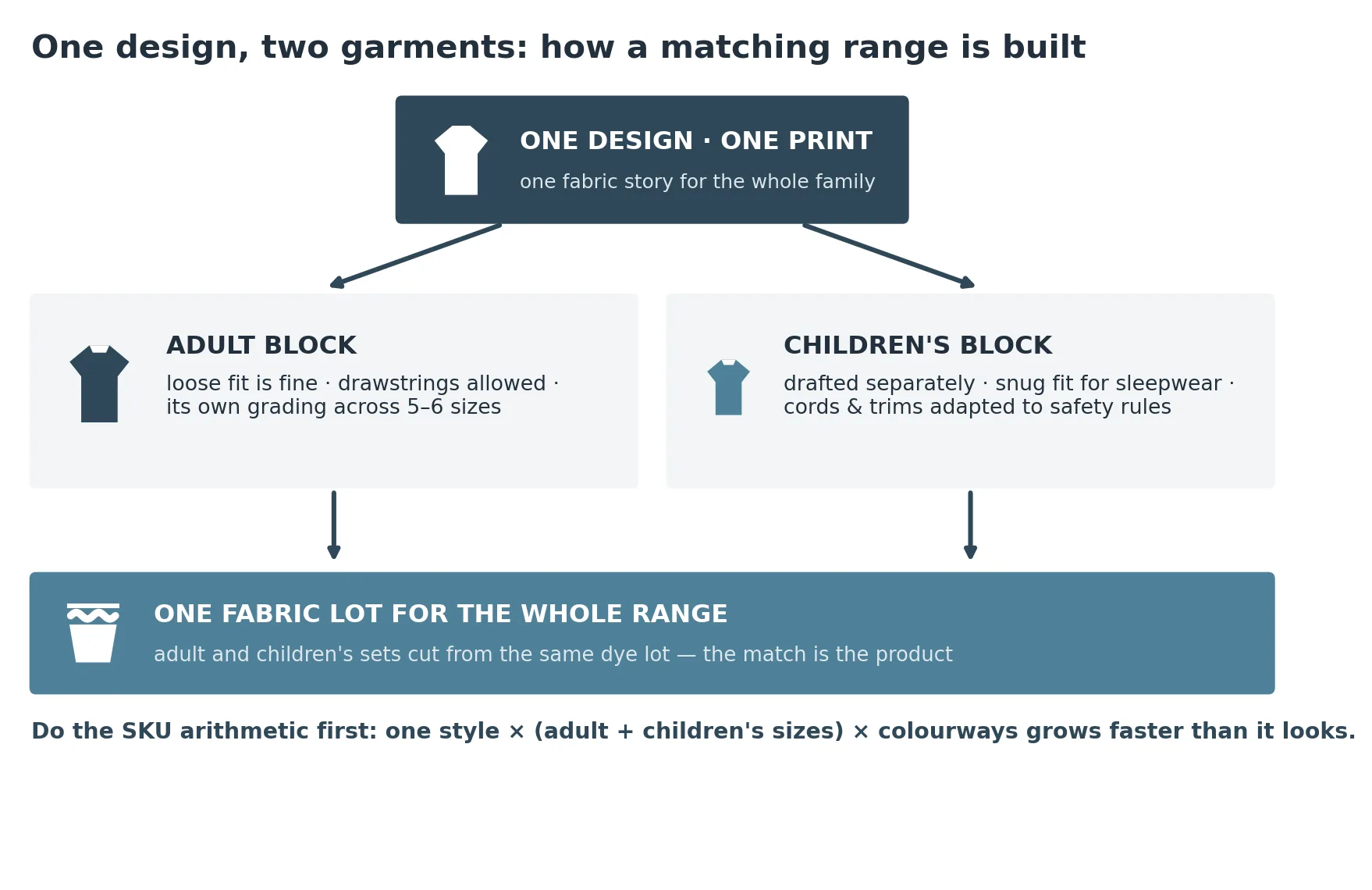
Start with the size architecture, because it multiplies everything
A typical family range runs adults in five or six sizes, children across six to eight sizes from toddler to teen, sometimes a baby size or two on top. Multiply one style by that size spread and every colourway, and a “simple matching set” is quietly a range of dozens of SKUs — each needing patterns, grading, markers, size labels and stock decisions. None of that makes it a bad idea; holiday matching ranges are a proven seasonal engine. It makes it an idea whose arithmetic should be done on paper first: which sizes are the commercial core, which exist to complete the family photo, and where the range can be trimmed without breaking the concept.
The children’s version is adapted, not shrunk
Children are not small adults, and their patterns aren’t either. Proportions differ — heads are larger relative to bodies, necks and shoulders sit differently — so the children’s block is drafted separately, with its own grading, even when every visible design line matches the adult version.
Safety rules then adapt it further. The drawstring that finishes the adult hood or waistband is restricted or banned outright on young children’s garments; trims, buttons and appliqués face small-parts thinking; and if the children’s set is sleepwear, the fit itself may be a compliance feature — in the US, children’s pajamas commonly qualify through a snug fit, while the matching adult set is free to be as loose as it likes. Same print, same fabric, two fits. Our children’s sleepwear compliance guide covers the rules behind those adaptations; the planning point is simpler: expect two blocks, two fittings and two sample rounds, and schedule them as one linked project rather than discovering the second one late.
Print scale: the decision nobody expects
An all-over print is designed once, at one scale. Run it at that scale on every size and it reads proportionally larger on a four-year-old than on her father — which many brands love, because it looks playful and unmistakably matched. Others prefer the print scaled per size group, which means separate print files (and for screen-printed placement designs, separate screens) for adults and children. Neither is wrong; both are expensive to reverse after fabric is printed. Placement prints — a chest motif, say — almost always need per-group sizing: a motif sized for an adult chest swallows a toddler’s. Decide the print policy at design stage and write it into both tech packs.
One fabric lot for the whole family
The entire commercial point of the product is that the sets match — which makes shade consistency a product feature, not a quality nicety. The adult set and the children’s set have to come from the same dye lot, or the family photo shows two cousins of the print instead of twins. That drives the fabric plan: quantities for all size groups are calculated together and the fabric is ordered as one lot for the range, with the children’s and adults’ cutting planned from it. It also means a mid-season reorder may not match the first run exactly — worth a line in your customer communication before a parent discovers their late-ordered set is half a shade off the one bought in October. (Why lots differ at all is the dye-lot story we tell in our sample vs bulk guide.)
Sets, separates and the packaging question
Matching ranges sell two ways: as individual sets per family member (the usual model — mum’s set, dad’s set, kids’ sets, each bagged and barcoded separately) or as bundled gift sets. The choice changes the finishing line: individual sets keep standard packing with range-specific labels; bundles need collation, combined packaging and their own barcodes. Photoshoot and influencer samples are the forgotten line item — a matching range needs samples in at least one adult and one child size to be marketed at all, and those come out of the same sample rounds as the fit approvals if someone remembers to ask.
Planning backwards from the season
Matching pajamas are a seasonal product wearing a calendar. The selling window is short and immovable — nobody clears Christmas prints in January at full price — so the range is planned backwards from the shelf date: retail delivery, shipping, production, sampling of two blocks, fabric. Worked backwards honestly, the start date is earlier than most first-time family ranges expect, and the cost of a slipped approval compounds faster than in a normal range, because two blocks’ worth of decisions queue behind each other. The brands that land it treat the children’s block as the critical path: it carries the compliance questions, the separate grading and the print adaptations, so it starts first.
Done that way, the range is genuinely simple where it should be — one fabric, one print story, one photo that sells the whole family — and properly engineered where it must be: underneath, in the blocks nobody sees.
About Jiajia: Zaozhuang Jiajia Garment Co., Ltd. has made knit apparel in Shandong, China since 2005 — pajamas, loungewear and children’s knitwear for overseas brands and wholesalers, including family matching ranges. Planning a matching set line for next season? Send us the size architecture you have in mind, and we’ll map the blocks, the fabric plan and the sample rounds it needs. Contact us.
Let’s discuss your collection
Tell us what you are planning to make.