
FOB, CIF or DDP? Clothing Import Terms Explained — and What “Landed Cost” Really Means
Two factories quote you for the same hoodie. One says 8 dollars FOB, the other says 9.20 DDP, and for a moment it looks like a simple comparison. It isn’t — because those two prices end at different places. The first stops at a ship’s rail in China. The second walks all the way to your warehouse door, carrying freight, insurance, customs and duty inside it. Comparing them directly is how buyers pick the “cheaper” quote and pay more.
The three-letter terms (they’re called Incoterms, maintained by the International Chamber of Commerce) exist to stop exactly that confusion. Each one draws a line through your shipment’s journey and says: costs on this side are the seller’s, costs on that side are the buyer’s — and risk changes hands at a specific point too, which is not always the same point. Here’s the journey, then the three terms clothing buyers actually use.
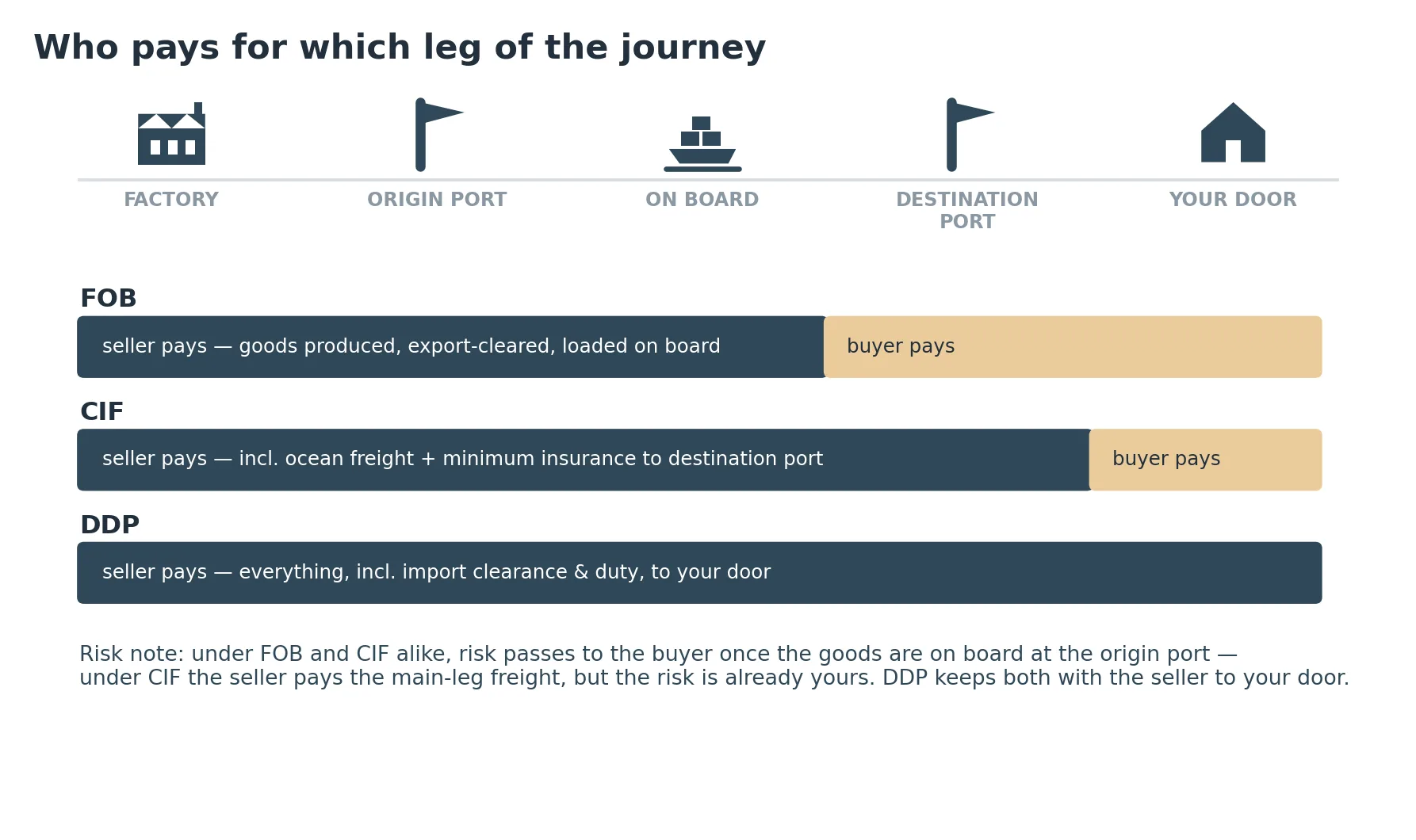
The journey every shipment takes
Your garments travel in legs: factory to the origin port, loaded onto the vessel, the ocean (or air) leg, arrival and handling at the destination port, import customs, and the final road leg to your door. Every leg costs money, and at every moment somebody bears the risk if the goods are damaged or lost. A trade term is simply an agreement about where, along that journey, the seller’s responsibility stops and yours starts.
FOB — free on board
Under FOB (always named with a port — FOB Qingdao, FOB Shanghai), the seller produces the goods, clears them for export, delivers them to the port and loads them on board the vessel. From the moment the goods are on board, cost and risk are yours: you arrange and pay the ocean freight, insurance, destination port charges, import duty and the delivery to your warehouse.
FOB is the default among experienced importers because control sits with the buyer — your freight forwarder, your rates, your visibility. If you have a forwarder you trust, FOB usually gives the cleanest picture of what the goods themselves cost. If you don’t have one, FOB means building that side of the operation yourself, on your first order, which is its own kind of cost.
CIF — cost, insurance and freight
Under CIF (named with a destination port), the seller pays the ocean freight and buys insurance for the main leg, delivering the goods — on paper — to your port. What catches buyers out is the split: the seller pays costs further than their risk travels. Risk still passes to you when the goods are loaded on board at origin, even though the seller arranged the shipping. If something happens mid-ocean, it’s your insurance claim — on the policy the seller bought, which is required only to provide minimum cover.
Beyond your port, everything is still yours: port and handling charges, customs, duty, and the road leg home. CIF suits buyers who want the seller to handle the main leg but keep control at destination — just read the insurance for what it is, and consider whether minimum cover matches the value of what’s in the container.
DDP — delivered duty paid
DDP is the longest line a seller can draw: the seller bears cost and risk all the way to the named destination — typically your door — including import customs clearance and duty in your country. You receive goods; the logistics happened somewhere offstage. For a first small order with no forwarder and no customs broker, that convenience is genuinely valuable.
Go in with open eyes, though. DDP quotes bundle every cost into one opaque number, so you can’t see what’s product and what’s freight — and freight inside a DDP quote is rarely the cheapest freight available. And because the seller (or their agent) handles your country’s import declaration, your business may not appear as the importer of record, which matters for your own duty and tax records. None of that makes DDP wrong. It makes it a service you’re buying, priced accordingly — compare it against FOB plus your own freight quote, never against a bare FOB price.
The number that actually matters: landed cost
Whichever term you buy on, your business runs on landed cost — what one garment costs, all-in, sitting in your warehouse. The stack looks like this: the product price, plus export-side and main-leg freight, plus insurance, plus import duty, plus port and handling charges, plus customs brokerage, plus the final delivery leg. (What sits inside the product price itself — fabric, labour, decoration, sampling — is its own breakdown, and we’ve written that one too.)
Two habits keep landed cost honest. Compare every quote on the same basis: ask each supplier for the same term, or convert everything to landed cost with real freight numbers before deciding. And remember production terms sit upstream of shipping terms — the clock on all of this starts when production finishes, which is why the production stages matter to your delivery date as much as the sailing schedule does. Our FAQ covers the payment and ordering questions that usually arrive alongside the terms question.
So which term should a clothing brand choose?
Have a forwarder, or plan to import regularly? Start from FOB and build your own logistics knowledge — it’s an asset that compounds. Want the factory to carry the main leg while you keep destination control? CIF, with the insurance caveat understood. First order, small quantity, no logistics setup at all? DDP can be the pragmatic choice — priced as the convenience it is, and revisited once importing becomes routine. The term is a tool. The mistake isn’t choosing any of them; it’s comparing prices across them as if they were the same product.
About Jiajia: Zaozhuang Jiajia Garment Co., Ltd. has made knit apparel in Shandong, China since 2005 — T-shirts, sweatshirts, hoodies, pajamas and loungewear for overseas brands and wholesalers in 18+ countries. Send us your styles and your destination, and we’ll quote on the term that suits how you import — and show the breakdown, so you can compare it fairly against anyone. Contact us
Let’s discuss your collection
Tell us what you are planning to make.